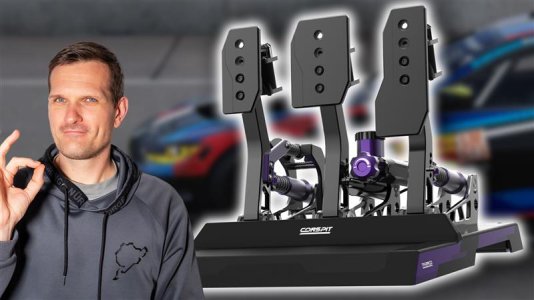
Conspit are a relatively new player on the sim racing hardware market, but they are looking to firmly get their foot in the door with products like the CPP Lite pedals. How does the set perform, though? Find out in our Conspit CPP Lite review!
If you are looking to upgrade your sim racing pedals or buy new ones soon, you should probably continue reading or watch the video version of this recview, because the Conspit CPP Lite pedals combine price and performance in perfect balance. A hydraulic brake system, rumble motors with SimHub support and therefore great adjustability are just some of the highlights.
A few months ago, at Sim Racing Expo 2024, we got the idea that Conspit has a strong lineup for PC sim racing. I was really looking forward to testing some of their products in detail, and here is what I learned about the CPP Lite pedals.
Visiting Conspit at SimRacing Expo 2024 left a good impression about the company's gear.
Pedals: The Most Important Rig Upgrade
I think a good pedal set is the most important upgrade for any sim rig. Sure, detailed Force Feedback and a properly functioning wheelbase also add a lot to the experience and immersion, but accelerating and braking is the element that brings the overall control of a car together, and there is a reason they say that races are won on the brakes.Conspit seems to think so too, because pedals are a high priority for them, as you can see by the fact that they are right at the top of the product overview on their website. The CPP Lite is their mid-range pedal set, available as a 2-pedal version or as a set with a clutch. In terms of price, it makes sense to order them with a clutch unless you are sure you will never need it. But I can tell you right away that it's really great to use - more on that later, however.
Conspit does not have its own shop, but rather lists a network of distributors in the different countries, for example PassionSim for the USA and Canada. As for the prices in €, they include taxes already, but shipping will of course be added to the total.
Hydraulics & Haptic Motors For €700
For about €700, the CPP Lite three-pedal set is currently positioned as the entry-level hydraulic model. Hydraulic means that the brake pedal uses a fluid-filled cylinder with a pressure sensor of up to 100 bar in the case of the CPP Lite, which allows a force of about 800N, and that means about 80 kilograms of force. In my opinion this is sufficient and a sweet spot, even if you drive wearing shoes. The subjective maximum pedal pressure on the brake is very similar to the three 100 kg load cell pedal sets we compared here last year.The topic of load cells versus hydraulic brakes could make for an article of its own, as both have their advantages and disadvantages. Basically, pure load cell pedals are somewhat more precise, adjustable to a finer degree and might require less maintenance as they have no fluids and fewer moving parts. On the other hand, hydraulic brakes are designed to mimic a more realistic feel of a brake like in a real car and a more natural pressure point. Let us know if you'd like us to take a closer look at this in the future!
However, well-made pedal sets can compensate for these advantages and disadvantages. For instance, Asetek Forte comes close to a hydraulic feel as a load cell kit, and conversely Conspit also has some solutions here to deliver a very precise braking feel that can also be adjusted. It requires maintenance in the form of an elastomer lubricant refresh from time to time, as well as dust cleaning of the moving components inside the rubber cylinder, according to Conspit.
Conspit CPP Lite: What's in the box?
Let's look at the packing list and assembly. Conspit always has a sketch showboard with their products, which I really like, and it gives the whole thing a touch of fun. There are also some stickers and an easy-to-understand manual that mainly relies on illustrations.There are also the three CPP Lite pedal elements, which are almost all metal, a plastic base plate, spare elastomers, cables and tools, including a tool for adjusting the hydraulic preload. A template for the size and holes of the pedal plate can be downloaded from the Conspit website, so you can check if the base plate fits the pedal plate of your rig.
Assembly & Adjustment
With our Sim-Lab rigs, everything is easy to adjust, so there were no problems at all. The assembly itself was quite easy. A few screws are a bit fiddly, and I didn't feel too comfortable with a screw sitting on top of one of the cables. The connections at the bottom of the pedal plate should be correct from the start, otherwise there will be problems later: throttle plugs into CH1, brake into CH2, clutch into CH3.Compared to a full-metal alternative, the plastic base plate feels slightly less premium, so if that's important to you, the CPP Evo set would be the right choice as there is more use of metal. The Evo Brake also has a more powerful sensor that can handle up to 1440N or about 147 kilograms of force. But as mentioned, the force of the Lite is enough for me and the plastic did not bother me later when I was driving. Everything is stable in any case and the cables are nicely hidden underneath.
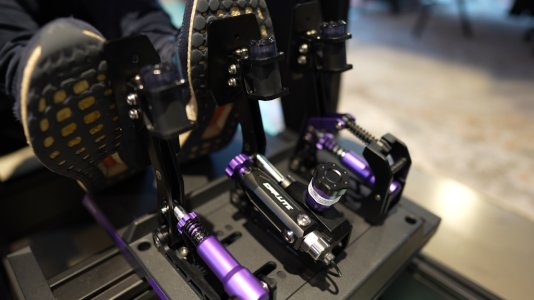
Of course, the pedals also have mechanical adjustment options to make them more ergonomic to your rig or your preferences. The pedal pads have a simple 0-15 degree angle adjustment and can also be changed in height. With the throttle pedal, we have four positions with a locking pin that we can use to adjust the force, and the travel can also be adjusted with a knob.
The travel range is very good, from a really short 1.5 cm for full grip/full throttle cars where we want to be at 100% as quickly as possible, to about 10 cm of travel for scenarios that require finer modulation, such as rallying on gravel. Just like the clutch, there is a Hall sensor behind the pedal, which responds very directly and linearly, so nothing to complain about!
The star of the show is undoubtedly the brake, which also uses the locking pin system for fine adjustment of force and pedal feel. The different positions, in conjunction with the hydraulic pressure, are intended to represent different types of motorsports, so that the lower positions are more in line with sports cars, while the more upright positions are more in the GT3 or F1 direction.
And that has worked very well for me so far. The tight setting at the top was my favorite in the end, very similar to the Asetek Forte brake that won our load cell comparison back then. You should release the hydraulic preload via the knob before making any changes to the locking pin, then turn it back up. One thing to keep in mind with the brake and throttle is that the higher the force, the faster the pedal returns, which can be unsettling depending on the car you're driving.
I highly recommend practicing the return of the throttle and brake with your foot, not just the application of pressure. This pedal set allows you to work on your setup and driving but also feels good out of the box without changing anything.
The clutch reinforces the positive impression of the set. Here too, consistent thought has been put into it, because with this two-stage spring system a bite point is mechanically simulated. Most clutch pedals from other manufacturers only do this half-heartedly via the angle, here you really notice the engagement point. Whether this then matches the clutch bite point of the car being driven in the sim is another matter, but here too it can be adjusted on the pedal. During my tests in AMS2 and WRC, I had a lot of fun with the clutch and the spacing of the set is also perfect for heel-and-toe shifting.
Software
With the Conspit Link software, most things worked fine so far - all the important features and firmware updates are available there. Calibrating during the initial setup and setting small dead zones are definitely necessary to get the pedals to work cleanly and without phantom input from 0-100%. I also recommend checking from time to time during the first few days to see if the calibration has remained intact. I had to readjust one or two times after which no more changes occurred.Conspit even has a small overlay that can display pedal telemetry while driving. A nice tool, especially if you are working on refining your pedal technique. I found that a little less brake pressure worked better for me. Especially the LMGT3 and Hypercars in LMU or the Porsche Cup in iRacing often require very precise trail braking to keep the cars stable in the corners.
So you have to be careful when you take your foot off the brake and not do it suddenly. At 100 bar, the pedal was released too quickly in the first third. I wonder if in the future the manufacturers could offer something like what is used in car suspensions - rebound and compression, one pressure value for engagement and one for release. What would you think of that?
Conspit CPP Lite Haptic Motors
Let's talk about the elephant in the room - I would call it the cherry on the cake or, in this case, the elephant on the cake: the haptic rumble motors. In Conspit Link you can already see that you can control these three motors on the pedals with different effects. Simagic also offers something similar, and there are various DYI shaker solutions, but the fact that this is included out of the box is a huge plus.However, since you can only set one effect and its intensity per pedal, forget Conspit Link and use SimHub, which also supports the pedals and motors. Interestingly, the throttle and clutch assignments on the motors were swapped, but I simply renamed them to solve this. This opens up a lot of possibilities and telemetry data that can be used for small vibrations on all three pedals.
SimHub offers a much wider range of effects that can be applied to the CCP Lite's haptic motors compared to the Conspit software.
The motors themselves are a bit noisy and the frequency band of the effect is not super dense and grainy. You can’t fine tune the frequency of the vibration but regardless, it is incredibly helpful to have this extra sensor. From Wheel Lock, Wheel Slip, ABS and TC Activation to Jump Landing in WRC, you can configure everything, even multiple effects per pedal, wonderfully in SimHub and Conspit even has a separate manual for setting it up with SimHub.
SimHub also offers much more compatibility than the rumble functions of the Conspit Link software. However, Conspit will certainly improve the latter and make more possible in the future. Either way, this is a huge bonus, whether you want additional effects for immersion or to feel the car's systems better. Believe me, once you've had an active pedal or haptics, you won't want anything else.
Conspit CPP Lite Review: Verdict
Even without the rumble motors the Conspit CPP Lite pedal set would have scored well. All three pedals give a good feel, especially the brake is absolutely stable and combines a natural feel with full precision. I claim that this pedal set can make 99% of sim racers happy in the long run.In this price range, the CCP Lite would be among my first choices, they are a 9/10 for me. Conspit should be on the radar of more sim racers this year, what we have seen so far is good quality gear at a fair and competitive price. You can tell there are people at work here that come from the hobby and want to make things better.
There is still room for improvement in the software, however. SimHub is great, but as a manufacturer you should ideally not rely on it and neglect your own software. But this is also true for many big manufacturers like Fanatec or Thrustmaster.
What are your impressions of the Conspit CPP Lite pedal set? Did you find our review helpful? Let us know in the comments below and join the discussion in our hardware forum!