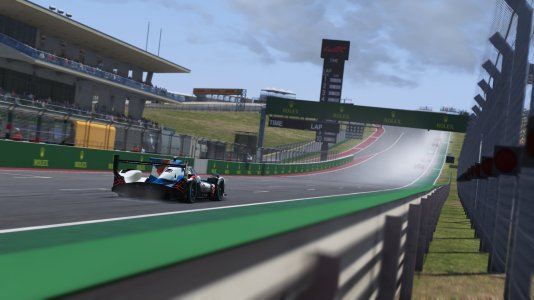
The wet weather model in Le Mans Ultimate may be a work in progress, but with some elements to look out for, this is your guide to racing in the rain in LMU.
Endurance racing. A motorsport discipline all about running immense distances across any conditions the circuit, your competitors and the weather decides to throw at you. That means that a realistic weather simulation and knowledge of how to survive it is critical to a successful sim racing game focusing on long distance motorsport.
That is where Le Mans Ultimate comes in as the official game to the FIA World Endurance Championship and the 24 Hours of Le Mans. In fact, you might remember that the last few editions of the Mulsanne endurance have faced, you could say, the odd drop of rain.
So with that in mind, here is your guide to best navigating adverse conditions in Le Mans Ultimate and become the one and only Rain Meister of LMU.
Ever since launch, the game's developers have been keen to point out that puddles in particular are merely a visual detail in LMU's current form. Sure, water may build up visually on-track in certain areas making for stunning screenshots. But when it comes to driving through these puddles, the car will not be affected.
Indeed, you will never feel the effects of aquaplaning as the water overwhelms your wet tyre tread, nor will the water's resistance drag the car about as it does in other games like iRacing and Assetto Corsa Competizione.

Le Mans Ultimate: Wet line is not yet fully effective.
Elsewhere, a scroll through the title's official Discord channel will reveal that work is ongoing into other aspects of the wet weather simulation. On several instances have the team behind the game noted that running the wet line is rarely worth it as it is in iRacing. Notably, it seems rubber on the racing line gets washed away far too quickly versus real life meaning that the effects of slippery rubber are not enough to warrant avoiding. Though hints do suggest it is a work in progress.

Development ongoing on LMU wet line.
For the most part, racing in the rain in LMU is a relatively easy process compared to other titles like the immensely detailed iRacing. A more simplistic model in its current guise, think of wet weather driving in the official WEC game as an overall loss of grip. With wet tyres fitted, that loss is far less than with slicks however and so you needn't alter your driving style all that much.
Be more progressive on the power and don't use quite as much braking potential - by extension, extending your braking markers by a few metres to make up for reduced efficiency of your brakes.

Weather in Le Mans Ultimate may not be complete but it is gorgeous. Image : Motorsport Games
This may be the best way of tackling the majority of wet situations in Le Mans Ultimate, but that only works when the track is fully wet and there is no change in sight from the forecast. In races with a more dynamic outlook, you may want to consider the following scenarios.
In general, and as we mention in our LMU Strategy Guide, we would advise switching to the wet tyres once the game's Multi-Function Display describes the track as Wet. Moist and Damp are relatively safe on slicks in our experience. At this point, the in-game engineer will also advise you to switch rubber, suggesting that wets are optimal.
For the reverse situation, things are even easier. It seems that in their current state, Le Mans Ultimate wet tyres are rather sturdy even in drying conditions and so you shouldn't lose too much time even on a dry track. If you are contemplating making the switch, we suggest waiting until the end of your stint and taking a fresh set of slicks at your scheduled fuel stop, rather than adding an extra trip down pitlane to your race time. To preserve your wet tyres' life, you can move off-line onto a wetter part of the track down the straights to cool them down.

You rarely run the wet line in LMU. Image : Motorsport Games
However, that isn't to say alternative lines needn't ever be taken into consideration. We have found that in one particular case, it may well be worth avoiding the rubbered line. Picture this, the track has been worn-in for a lengthy race and is now saturated with rubber, but what is this, a sprinkling of rain leaves the circuit surface a little moist.
In this particular case, the amount of water is not yet enough to wash away rubber and there is a lot to wash away. As such, for the first half-dozen laps of notable moisture, we would recommend braking slightly off-line to avoid lock-ups and avoiding the racing line through faster turns. After a few laps of rain however, revert to the regular, faster line as any rubber will disappear fairly quickly.
Firstly, sending it into the pits in the rain is never a great idea as spins and lock-ups will not only lose you a bit of time, but pit speeding penalties can effectively end your race.

Keep Le Mans Ultimate's dynamic drying line in mind.
Secondly, as the game's Discord server highlights, the drying of the track is a dynamic feature and so the the racing line itself will dry much quicker than the less-used areas of tarmac. As a result, sticking to the racing line in this pivotal part of the race is crucial to ensuring you avoid crashes. Additionally, when your wet tyres begin to overheat, running off-line on the straights to use water to cool them down is extremely beneficial.

Softer setups work best in the rain. Image : Motorsport Games
As a simple go-to, we would recommend adding as much downforce as you can by increasing the wing angle on your car. Depending on the model, this will alter the aero balance in different ways, so for cars with a front aero device like the Peugeot 9X8, maybe go easy on this particular note to avoid a Verstappen-friendly spin top of a car.
For increased low-speed grip, soften up both the springs and Anti-Roll Bars equally both front and rear and you should find yourself with a more compliant racer. Though faster direction changes may suffer as a result.
Do you enjoy racing in wet weather in Le Mans Ultimate? Let us know in the comments below and join the discussion in our LMU forum!
Endurance racing. A motorsport discipline all about running immense distances across any conditions the circuit, your competitors and the weather decides to throw at you. That means that a realistic weather simulation and knowledge of how to survive it is critical to a successful sim racing game focusing on long distance motorsport.
That is where Le Mans Ultimate comes in as the official game to the FIA World Endurance Championship and the 24 Hours of Le Mans. In fact, you might remember that the last few editions of the Mulsanne endurance have faced, you could say, the odd drop of rain.
So with that in mind, here is your guide to best navigating adverse conditions in Le Mans Ultimate and become the one and only Rain Meister of LMU.
Le Mans Ultimate Rain: WIP
As is the case with many pieces of the Le Mans Ultimate puzzle, the title's weather model is somewhat half-baked in this early access form. Since launch, both the rain physics and progression of weather have been pushed to the side somewhat in favour of other elements so it is worth knowing what works and what doesn't in order to optimise your wet racing.Ever since launch, the game's developers have been keen to point out that puddles in particular are merely a visual detail in LMU's current form. Sure, water may build up visually on-track in certain areas making for stunning screenshots. But when it comes to driving through these puddles, the car will not be affected.
Indeed, you will never feel the effects of aquaplaning as the water overwhelms your wet tyre tread, nor will the water's resistance drag the car about as it does in other games like iRacing and Assetto Corsa Competizione.
Le Mans Ultimate: Wet line is not yet fully effective.
Elsewhere, a scroll through the title's official Discord channel will reveal that work is ongoing into other aspects of the wet weather simulation. On several instances have the team behind the game noted that running the wet line is rarely worth it as it is in iRacing. Notably, it seems rubber on the racing line gets washed away far too quickly versus real life meaning that the effects of slippery rubber are not enough to warrant avoiding. Though hints do suggest it is a work in progress.
Development ongoing on LMU wet line.
How To Tackle Wet Racing In LMU
Now that we know what works and what does not work in Le Mans Ultimate's weather simulation, it is time to figure out how to cope with its challenges.For the most part, racing in the rain in LMU is a relatively easy process compared to other titles like the immensely detailed iRacing. A more simplistic model in its current guise, think of wet weather driving in the official WEC game as an overall loss of grip. With wet tyres fitted, that loss is far less than with slicks however and so you needn't alter your driving style all that much.
Be more progressive on the power and don't use quite as much braking potential - by extension, extending your braking markers by a few metres to make up for reduced efficiency of your brakes.
Weather in Le Mans Ultimate may not be complete but it is gorgeous. Image : Motorsport Games
This may be the best way of tackling the majority of wet situations in Le Mans Ultimate, but that only works when the track is fully wet and there is no change in sight from the forecast. In races with a more dynamic outlook, you may want to consider the following scenarios.
Wet Weather Strategy
When it comes to strategy in rainy conditions, you have two basic options. Either slap a set of wet tyres on and make up the time for a pitstop or stick it out on slicks and hope the track dries up just as quickly as it became a river.In general, and as we mention in our LMU Strategy Guide, we would advise switching to the wet tyres once the game's Multi-Function Display describes the track as Wet. Moist and Damp are relatively safe on slicks in our experience. At this point, the in-game engineer will also advise you to switch rubber, suggesting that wets are optimal.
For the reverse situation, things are even easier. It seems that in their current state, Le Mans Ultimate wet tyres are rather sturdy even in drying conditions and so you shouldn't lose too much time even on a dry track. If you are contemplating making the switch, we suggest waiting until the end of your stint and taking a fresh set of slicks at your scheduled fuel stop, rather than adding an extra trip down pitlane to your race time. To preserve your wet tyres' life, you can move off-line onto a wetter part of the track down the straights to cool them down.
When To Run The Wet Line
As aforementioned, running the wet line is not particularly useful in most cases. The effects of wet rubber on-track are not as aggressive as they are in real life and any rubber that does get laid down washes away relatively quickly with a bit of rain.You rarely run the wet line in LMU. Image : Motorsport Games
However, that isn't to say alternative lines needn't ever be taken into consideration. We have found that in one particular case, it may well be worth avoiding the rubbered line. Picture this, the track has been worn-in for a lengthy race and is now saturated with rubber, but what is this, a sprinkling of rain leaves the circuit surface a little moist.
In this particular case, the amount of water is not yet enough to wash away rubber and there is a lot to wash away. As such, for the first half-dozen laps of notable moisture, we would recommend braking slightly off-line to avoid lock-ups and avoiding the racing line through faster turns. After a few laps of rain however, revert to the regular, faster line as any rubber will disappear fairly quickly.
The Drying Line In Le Mans Ultimate
On the contrary, it seems the drying line is far more prominent. You will notice this best when heading towards the pits from a drying track as the circuit itself may be clear of standing water, but the pitlane entry will still suffer from a dramatic loss of grip. This is crucial to understand for a number of key reasons.Firstly, sending it into the pits in the rain is never a great idea as spins and lock-ups will not only lose you a bit of time, but pit speeding penalties can effectively end your race.
Keep Le Mans Ultimate's dynamic drying line in mind.
Secondly, as the game's Discord server highlights, the drying of the track is a dynamic feature and so the the racing line itself will dry much quicker than the less-used areas of tarmac. As a result, sticking to the racing line in this pivotal part of the race is crucial to ensuring you avoid crashes. Additionally, when your wet tyres begin to overheat, running off-line on the straights to use water to cool them down is extremely beneficial.
Le Mans Ultimate Wet Setup Guide
If you are still struggling to make it around the lap safely under rainy conditions, there are a number of setup tweaks you can make to ensure your wheels grip the track surface.Softer setups work best in the rain. Image : Motorsport Games
As a simple go-to, we would recommend adding as much downforce as you can by increasing the wing angle on your car. Depending on the model, this will alter the aero balance in different ways, so for cars with a front aero device like the Peugeot 9X8, maybe go easy on this particular note to avoid a Verstappen-friendly spin top of a car.
For increased low-speed grip, soften up both the springs and Anti-Roll Bars equally both front and rear and you should find yourself with a more compliant racer. Though faster direction changes may suffer as a result.
Do you enjoy racing in wet weather in Le Mans Ultimate? Let us know in the comments below and join the discussion in our LMU forum!