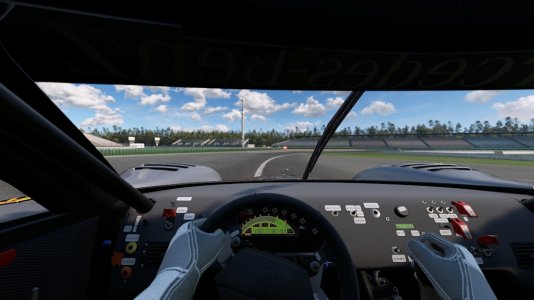
It is easy to lose track of the specifics of the vast content selection in sim racing - particularly for older cars. Here's what common car classes use as a shifting method.
Racing and technological progress are inseparable. That means that the way cars are driven has changed considerably over the decades, which is also obvious within sim racing. Those who love running classic cars will know this very well, but even if you are only focusing on modern machinery, it's not always as straight-forward as assuming that every vehicle uses paddle shifters.
As a base resource, there is a handy iRacing Support Gearbox Guide, which naturally only covers the cars available in the sim, but should be helpful for other cars in the same classes available elswhere, too. For now, let's have a look at the three main shifting methods in sim racing.

1970s Grand Prix drivers such as Ronnie Peterson were still firmly in H-shifter territory.
This was made somewhat easier via so-called dog boxes which allow to shift without the clutch - but many drivers still did, be it out of habit or to ensure smoother gear changes that bore less potential for damaging the gearbox. They also still needed to rev match on downshifts (so blip the throttle). This type of gearbox goes back even to the 1960s, but was more commonly found later on.
Notable examples for dog box cars include early 1990s DTM, later Group C cars such as the Sauber-Mercedes C9, Porsche 962C or Mazda 787B, or F1 cars that raced in the late 1980s and early 1990s. In those, you still need to lift the throttle on upshifts.

On the 1991 F1 grid, Williams and Ferrari were the only teams using paddle shifters. H-shifters like in Ayrton Senna's McLaren (right) were entirely out of the sport just a few years later, though.
Formula One cars are typically a tricky subject when it comes to their shifting method since the arrival of sequential gearboxes happened gradually and not all at once - we recommend researching the particular car you want to drive to make sure. Otherwise, many games and sims also tell you in their UI which shifting method a car used.
The 1989 Ferrari 640 was the first F1 car to sport paddle shifters, and Williams followed suit in 1991. McLaren did in 1992, and Benetton finally adopted paddle shifters in 1993. The final H-shifter car to ever win an F1 Grand Prix and a World Championship was the 1991 McLaren MP4/6, and by 1993, most of the grid had graduated to paddles. The 1994 Simtek S941 and the 1995 Forti FG01 were the last-ever F1 cars with a manual gearbox.

The Super Touring cars of the 1990s are prominent examples of cars using manual-sequential gearboxes.
They are much simpler than a traditional H-shifter in that the drivers pull the lever towards themselves to shift up, and push it away to shift down. Depending on the level of the system's sophistication, they still required drivers to blip the throttle on downshifts, but allowed for left-foot braking.
For smoother downshifts, however, particularly in endurance racing or the Australian V8 Supercars, drivers used (and in the case of Supercars still use) heel and toe on downshifts.
Note: This list is not comprehensive, and the titles mentioned for the car classes are merely suggestions. We're happy to add more, of course - simply leave your suggestions in the comments!

Most modern race cars like the Ferrari 488 Challenge Evo feature paddle shifters. Image: Kunos Simulazioni
Sportscars took a bit longer, but by the 2010s, paddle shifters had become the norm. These days, there are few exceptions, the most notable ones being NASCAR, Aussie Supercars, WRC and a multitude of US-based Dirt Oval racing classes.
As a result, you should be fine opting for paddle shifters in almost anything from around that time or newer. It is also possible to easily drive manual-sequential cars with paddles if you switch on auto clutch, if you so desire, so a wheel with paddle shifters on it will serve you well across a number of classes.
The benefits of this system are quite obvious: Drivers do not have to take a hand off the wheel to shift, they only need to operate two pedals in most cases (as wheel-mounted clutch paddles are quite common), and shifts are lightning-quick while there is also much less potential for misshifts. Clicking the right paddle will shift into a higher gear, and pulling the left paddle goes down a gear - it could hardly be simpler, and as a result, this method is very approachable.
If you are at the very beginning of your sim racing journey, using paddle shifters to learn how to shift gears yourself is arguably the best starting point. This way, you can learn about shifting points (i.e. in which rev range you should be) and the effects of attacking a certain part of a track in a higher or lower gear without having to worry about using the clutch correctly.
Once driving a paddle-shifted car is second nature, moving on to manual-sequential cars could be your next step, and once you conquered that, the rather complicated discipline of heel and toe might await if you want to pick up that technique as well.
Which shifting method is your favorite when you are racing yourself? Let us know in the comments below!
Racing and technological progress are inseparable. That means that the way cars are driven has changed considerably over the decades, which is also obvious within sim racing. Those who love running classic cars will know this very well, but even if you are only focusing on modern machinery, it's not always as straight-forward as assuming that every vehicle uses paddle shifters.
As a base resource, there is a handy iRacing Support Gearbox Guide, which naturally only covers the cars available in the sim, but should be helpful for other cars in the same classes available elswhere, too. For now, let's have a look at the three main shifting methods in sim racing.
1970s Grand Prix drivers such as Ronnie Peterson were still firmly in H-shifter territory.
H-Shifter
Being the traditional way of changing gears, H-Shifters can basically be found in any car up until the late 1980s when sequential gearboxes started appearing in racing cars more and more. While the layouts of these H-pattern shifters often differed from car to car, particularly in the early days, the general method was the same: Drivers operated three pedals in their cars, having to use the clutch when shifting gears.This was made somewhat easier via so-called dog boxes which allow to shift without the clutch - but many drivers still did, be it out of habit or to ensure smoother gear changes that bore less potential for damaging the gearbox. They also still needed to rev match on downshifts (so blip the throttle). This type of gearbox goes back even to the 1960s, but was more commonly found later on.
Notable examples for dog box cars include early 1990s DTM, later Group C cars such as the Sauber-Mercedes C9, Porsche 962C or Mazda 787B, or F1 cars that raced in the late 1980s and early 1990s. In those, you still need to lift the throttle on upshifts.
On the 1991 F1 grid, Williams and Ferrari were the only teams using paddle shifters. H-shifters like in Ayrton Senna's McLaren (right) were entirely out of the sport just a few years later, though.
Formula One cars are typically a tricky subject when it comes to their shifting method since the arrival of sequential gearboxes happened gradually and not all at once - we recommend researching the particular car you want to drive to make sure. Otherwise, many games and sims also tell you in their UI which shifting method a car used.
The 1989 Ferrari 640 was the first F1 car to sport paddle shifters, and Williams followed suit in 1991. McLaren did in 1992, and Benetton finally adopted paddle shifters in 1993. The final H-shifter car to ever win an F1 Grand Prix and a World Championship was the 1991 McLaren MP4/6, and by 1993, most of the grid had graduated to paddles. The 1994 Simtek S941 and the 1995 Forti FG01 were the last-ever F1 cars with a manual gearbox.
The Super Touring cars of the 1990s are prominent examples of cars using manual-sequential gearboxes.
Manual Sequential
While in Formula One, the jump happened straight from manual to paddle-shifted sequential gearboxes, that was not quite the case in other racing series, which took an intermediate step. Of course, paddle-operated gearboxes were fairly expensive, so many series that were not as high-level as F1 chose manual-sequential shifters, operated by a lever in the cockpit still.They are much simpler than a traditional H-shifter in that the drivers pull the lever towards themselves to shift up, and push it away to shift down. Depending on the level of the system's sophistication, they still required drivers to blip the throttle on downshifts, but allowed for left-foot braking.
For smoother downshifts, however, particularly in endurance racing or the Australian V8 Supercars, drivers used (and in the case of Supercars still use) heel and toe on downshifts.
Common Sim Racing Car Classes Using Manual-Sequential Gearboxes
| Class | Year(s) | Examples of Cars | Examples of Games | Notes |
|---|---|---|---|---|
| DTM | 2000 - 2011 | Abt-Audi TT-R, AMG-Mercedes CLK-DTM, AMG-Mercedes C-Klasse, Audi A4 DTM, Audi TT, Opel Astra V8 Coupé, Opel Vectra GTS V8 | Assetto Corsa (mods), RaceRoom, rFactor (mods) | all cars of the modern DTM from 2000 to 2011 used manual sequential, as paddle shifters became mandatory in 2012 |
| GT1 | ca. 1994 - 1998 | McLaren F1 GTR, Mercedes CLK-GTR, Porsche 911 GT1, Nissan R390 GT1, Toyota GT-One | Assetto Corsa, Automobilista 2, Project CARS 1/2 | some earlier cars such as the McLaren F1 GTR initially used manual gearboxes, but switched to manual sequential later (in this case in 1997), no auto-blip on downshifts |
| GT1 (formerly GT2) | 1999 - 2011 | Aston Martin DBR9, Chevrolet Corvette C5-R, Chrysler Viper GTS-R, Ferrari 550 GTS Maranello, Maserati MC12, Saleen S7R | Assetto Corsa, GTR1/2, iRacing, RaceRoom, Race 07 | no auto-blip on downshifts |
| IndyCar/CART/ChampCar | 1993 - 2006 (2008 for IndyRacing League) | Reynard 98i, Swift 009.c, Lola B2K00 | Assetto Corsa (mods), Automobilista (mods), Automobilista 2, rFactor (mods) | no auto-blip on downshifts in earlier models up to ca. 2002 |
| LMP1 (WSC)/ LMP900 | 1995 - ca. 2005 | BMW V12 LMR, Bentley Speed 8, Ferrari 333 SP, Panoz LMP-1 Roadster S, Toyota GT-One | Assetto Corsa, Project CARS 1/2, rFactor 2 (mods) | due to the variety of different concepts, even cars in 2000 such as the Audi R8 used paddle shifters while others carried on with manual sequential until the mid-2000s |
| NASCAR Cup | 2022 - today | Chevrolet Camaro ZL-1, Ford Mustang, Toyota Camry | iRacing, rFactor 2 (mods) | no auto-blip on downshifts |
| Super Touring Cars | ca. 1990 - 2001 | BMW E36, Ford Mondeo, Honda Accord, Opel/Vauxhall Vectra, Nissan Primera, Renault Laguna | Assetto Corsa (mods), RaceRoom, rFactor 2 (mods) | no auto-blip on downshifts |
| V8 Supercars | 2008 - today | Chevrolet Camaro, Ford Falcon, Ford Mustang, Holden Commodore | Assetto Corsa (mods), Automobilista 2, iRacing, rFactor 2 (mods) | no auto-blip on downshifts, real drivers often still use heel and toe |
| WRC | 1997 - ca. 2002, 2011 - today | Citroen DS3 WRC, Ford Fiesta RS WRC, Hyundai i20 N Rally 1, Mitsubishi Lancer Evo VI, Subaru Impreza WRC, Toyota GR Yaris Rally1 | DiRT Rally, DiRT Rally 2, EA Sports WRC, Richard Burns Rally | starting in 2001, push-pull paddle shifters started appearing in more and more cars while the "normal" sequential stick was still in the car as a backup |
Note: This list is not comprehensive, and the titles mentioned for the car classes are merely suggestions. We're happy to add more, of course - simply leave your suggestions in the comments!
Most modern race cars like the Ferrari 488 Challenge Evo feature paddle shifters. Image: Kunos Simulazioni
Paddle Shifters In Sim Racing
By far the most common shifting method in modern racing cars, paddle shifters first started appearing in F1 in 1989, as mentioned. Once Ferrari got the system working reliably - which included Nigel Mansell actually booking an early flight home from the season-opening 1989 Brazilian Grand Prix as he figured it would fail, only to go on and win the race - other teams followed suit quickly.Sportscars took a bit longer, but by the 2010s, paddle shifters had become the norm. These days, there are few exceptions, the most notable ones being NASCAR, Aussie Supercars, WRC and a multitude of US-based Dirt Oval racing classes.
As a result, you should be fine opting for paddle shifters in almost anything from around that time or newer. It is also possible to easily drive manual-sequential cars with paddles if you switch on auto clutch, if you so desire, so a wheel with paddle shifters on it will serve you well across a number of classes.
The benefits of this system are quite obvious: Drivers do not have to take a hand off the wheel to shift, they only need to operate two pedals in most cases (as wheel-mounted clutch paddles are quite common), and shifts are lightning-quick while there is also much less potential for misshifts. Clicking the right paddle will shift into a higher gear, and pulling the left paddle goes down a gear - it could hardly be simpler, and as a result, this method is very approachable.
If you are at the very beginning of your sim racing journey, using paddle shifters to learn how to shift gears yourself is arguably the best starting point. This way, you can learn about shifting points (i.e. in which rev range you should be) and the effects of attacking a certain part of a track in a higher or lower gear without having to worry about using the clutch correctly.
Once driving a paddle-shifted car is second nature, moving on to manual-sequential cars could be your next step, and once you conquered that, the rather complicated discipline of heel and toe might await if you want to pick up that technique as well.
Which shifting method is your favorite when you are racing yourself? Let us know in the comments below!