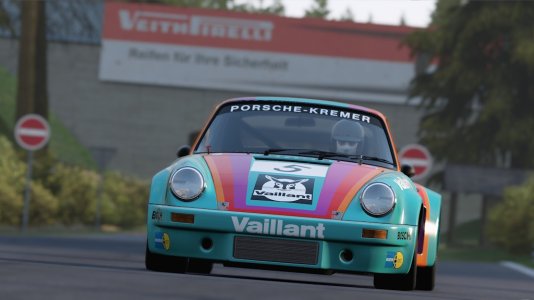
Racing classic cars is one of sim racing's exciting qualities. What hardware do you need for it, though? Here's our beginner's guide for those who want to dive into historic sim racing.
Sim racing in 2025 is what you want it to be. You can focus on the competitive side of racing in modern cars, and if you do, chances are you are very much into iRacing. On the other hand, there is the crowd that looks for immersion first and foremost - which can also include modern racing cars, but going back in time is a huge factor for many, too.
Driving the icons of your childhood or even from an era that you were not even alive in yet, simulators like Assetto Corsa with its countless high-quality mods, rFactor 2 and its similarly big pool of content, or Automobilista 2 offer plenty of combinations for the classic racing car enjoyer to run. RaceRoom recently also dove a bit deeper into classic content.
But for those who want to get as close to the real thing as possible, knowing where to find the content is just one part of the equation. There is a reason why trying to chuck around a Lotus 49 at a 1960s Nürburgring-Nordschleife feels a bit odd using a modern formula-style steering wheel and just two pedals. And as the question has popped up on OverTake before, we figured it might be time for a guide on what you might want to have in your hardware setup to enjoy classic cars in sim racing as they were intended to be driven.
While many sim racers already know what to look for, others might not - so here's what you need.

Image: MOZA Racing
Until paddle shifter started appearing in the late 1980s in Formula One and for a little while afterwards, most cars used a conventional H-shifter. Also called gated shifter sometimes, they kept drivers busy throghout most of motorsport's history, having to take a hand of the steering wheel to shift gears.
In the past, Logitech included a shifter with their G25 and G27 sets, but these days, they are sold separately. These days, there are plenty of choices out there that you can consider - and some of the high-end products can simulate gears being locked out if the clutch is not pressed. Of course, that will also result in a hefty price.
Furthermore, some shifters can easily be switched to a sequential mode. Manual sequential cars like in modern WRC and Australian Supercars or 1990s and 2000s GT cars did not use paddles yet, but rather a stick that you could pull back and push forward to shift through the gears, so for those somewhat more modern cars, you could consider one of the switchable shifters.
That takes care of the shifter, but to properly get going with practicing those heel and toe downshifts, you need something else as well.

Image: Sim-Lab
Now, you might be good to go already depending on your pedal set, as some sets by Logitech, Thrustmaster or Fanatec already feature a clutch pedal by default. However, as you move up the pedal ladder, there will be quite a few that omit the third pedal by default - great for those who want to spend less and only race modern cars anyway, but something to be aware of if you are looking for the full experience in historic cars.
Usually, those who offer two-pedal sets, which includes manufacturers like Asetek, Heusinkveld or Sim-Lab, also offer a clutch pedal separately or as an option to select when ordering their products initially.
Learning how to heel and toe is an entirely different story, however, but ithat is not part of a hardware guide, obviously. We have a guide for h-shifter technique on OverTake, but this could do with a rework - we shall add that to our list!

Image: Logitech
Formula-style wheel rims are designed with the thought that the driver does not have to take their hands off of it in mind. If you are using an h-shifter, your hand will come off the wheel frequently, and it will need to go back on the wheel, of course. With only one position for your hand to hold the wheel, this is a bit more difficult and perhaps not as comfortable.
Additionally, you can let the wheel glide through your hand as you slide a car around a corner in a controlled manner as it straightens itself out, which is particularly important in cars with little or no downforce, such as pre-1968 F1 cars. With a round wheel, it also does not matter as much where exactly you grab it after you took your hand off the wheel, as you can easily correct your grip.
While the higher-end sim racing steering wheels are Formula-style wheels most of the time, as they are present in most modern racing cars with or without roofs, there are several options for round wheels, too. Some wheel bases come bundled with one by default, such as the Logitech models.
As a bonus, round wheels work well for pretty much any rally car as well as drifting, too. It is important to pay attention to their diameter, though - the small 270mm wheels are a good fit for classic F1 cars, but might make wrestling around a much heavier 70s GT car more difficult. A good compromise are wheels with a diameter of around 320mm.
Your wheel also does not have to perfectly round, strictly speaking. A flat bottom or top can work well, too.
With a combination of the three, you will probably feel like your Grand Prix or sportscar heroes from past decades in no time.
If you want to get as close as possible to how these cars were actually driven, a shifter, clutch pedal and round wheel are something to strongly consider, however.
If you are planning on buying some of the gear mentioned in this article and you like what we do here at OverTake, please consider using our affiliate link to Asetek, Fanatec, MOZA Racing or Sim-Lab. We make a small commission on each sale made using these links, without any extra costs for you. And with that, you support your favorite sim racing community, so that we can keep hosting all the downloads you need and post all the news, reviews, features and more.
How important is racing classic cars as authentically as possible to you? Let us know your thoughts in the comments below and join the discussion in our hardware forum!
Sim racing in 2025 is what you want it to be. You can focus on the competitive side of racing in modern cars, and if you do, chances are you are very much into iRacing. On the other hand, there is the crowd that looks for immersion first and foremost - which can also include modern racing cars, but going back in time is a huge factor for many, too.
Driving the icons of your childhood or even from an era that you were not even alive in yet, simulators like Assetto Corsa with its countless high-quality mods, rFactor 2 and its similarly big pool of content, or Automobilista 2 offer plenty of combinations for the classic racing car enjoyer to run. RaceRoom recently also dove a bit deeper into classic content.
But for those who want to get as close to the real thing as possible, knowing where to find the content is just one part of the equation. There is a reason why trying to chuck around a Lotus 49 at a 1960s Nürburgring-Nordschleife feels a bit odd using a modern formula-style steering wheel and just two pedals. And as the question has popped up on OverTake before, we figured it might be time for a guide on what you might want to have in your hardware setup to enjoy classic cars in sim racing as they were intended to be driven.
While many sim racers already know what to look for, others might not - so here's what you need.
Image: MOZA Racing
H-Shifter
Modern racing cars come with sequential gearboxes, and the vast majority of them are operated via paddles on the steering wheel. Be it F1, Hypercars, GT3 or TCR - they all use paddles, so to some of the younger sim racers, the concept of using anything else might seem completely foreign.Until paddle shifter started appearing in the late 1980s in Formula One and for a little while afterwards, most cars used a conventional H-shifter. Also called gated shifter sometimes, they kept drivers busy throghout most of motorsport's history, having to take a hand of the steering wheel to shift gears.
In the past, Logitech included a shifter with their G25 and G27 sets, but these days, they are sold separately. These days, there are plenty of choices out there that you can consider - and some of the high-end products can simulate gears being locked out if the clutch is not pressed. Of course, that will also result in a hefty price.
Furthermore, some shifters can easily be switched to a sequential mode. Manual sequential cars like in modern WRC and Australian Supercars or 1990s and 2000s GT cars did not use paddles yet, but rather a stick that you could pull back and push forward to shift through the gears, so for those somewhat more modern cars, you could consider one of the switchable shifters.
Sim Racing Shifter Examples
| Brand | Model | RRP | Notes |
|---|---|---|---|
| Logitech | Driving Force Shifter | €64.99 / $59.99 | manual only, needs Logitech G Racing Adapter to work with Logitech G PRO wheel bases |
| Thrustmaster | TH8S Shifter Add-on | €69.99 / $69.99 | manual only |
| SHH | Thorn | €109 | switchable sequential mode, customizable exterior |
| MOZA Racing | SGP Sequential Shifter | €139 / $129 | sequential only |
| MOZA Racing | HGP Shifter | €159 / $149 | manual only |
| Logitech | RS Shifter & Handbrake | €159.99 / $149.99 | sequential only, switchable handbrake mode |
| Thrustmaster | TH8A Shifter Add-on | €199.99 / $199.99 | switchable sequential & handbrake modes |
| Simagic | Sequential Shifter Q1S | €247 / $259 | sequential only |
| Simagic | Sequential Shifter Q1 | €257 / $269 | sequential only |
| Fanatec | ClubSport Shifter SQ V1.5 | €269.95 / $269.99 | switchable sequential mode |
| Thrustmaster | TSS Handbrake | €299.99 / $299.99 | handbrake with switchable sequential mode |
| Simagic | DS-8X Shifter | €352 / $369 | switchable sequential mode |
| Heusinkveld | MagShift | €441.57 / $462.42 | sequential only |
| BDH | H1SQ Dual Mode | €1449.99 / $1518 | switchable sequential mode, tactile feedback |
That takes care of the shifter, but to properly get going with practicing those heel and toe downshifts, you need something else as well.
Image: Sim-Lab
Clutch Pedal
To some, it should go without saying, but as many sim racing pedal sets do not come with one, it needs to be a point in this guide: You need a clutch pedal to make the most of the shifter you have put on your rig.Now, you might be good to go already depending on your pedal set, as some sets by Logitech, Thrustmaster or Fanatec already feature a clutch pedal by default. However, as you move up the pedal ladder, there will be quite a few that omit the third pedal by default - great for those who want to spend less and only race modern cars anyway, but something to be aware of if you are looking for the full experience in historic cars.
Usually, those who offer two-pedal sets, which includes manufacturers like Asetek, Heusinkveld or Sim-Lab, also offer a clutch pedal separately or as an option to select when ordering their products initially.
Learning how to heel and toe is an entirely different story, however, but ithat is not part of a hardware guide, obviously. We have a guide for h-shifter technique on OverTake, but this could do with a rework - we shall add that to our list!
Image: Logitech
Round Steering Wheel
So, with your shifter and clutch pedal sorted out, there is one more thing that you should consider for your setup: a round steering wheel. Now, this is not strictly necessary, as any steering wheel that you can turn technically will do the job, but there is a reason why this is included.Formula-style wheel rims are designed with the thought that the driver does not have to take their hands off of it in mind. If you are using an h-shifter, your hand will come off the wheel frequently, and it will need to go back on the wheel, of course. With only one position for your hand to hold the wheel, this is a bit more difficult and perhaps not as comfortable.
Additionally, you can let the wheel glide through your hand as you slide a car around a corner in a controlled manner as it straightens itself out, which is particularly important in cars with little or no downforce, such as pre-1968 F1 cars. With a round wheel, it also does not matter as much where exactly you grab it after you took your hand off the wheel, as you can easily correct your grip.
While the higher-end sim racing steering wheels are Formula-style wheels most of the time, as they are present in most modern racing cars with or without roofs, there are several options for round wheels, too. Some wheel bases come bundled with one by default, such as the Logitech models.
As a bonus, round wheels work well for pretty much any rally car as well as drifting, too. It is important to pay attention to their diameter, though - the small 270mm wheels are a good fit for classic F1 cars, but might make wrestling around a much heavier 70s GT car more difficult. A good compromise are wheels with a diameter of around 320mm.
Your wheel also does not have to perfectly round, strictly speaking. A flat bottom or top can work well, too.
With a combination of the three, you will probably feel like your Grand Prix or sportscar heroes from past decades in no time.
Racing Classic Cars With "Modern" Hardware
Of course, it has to be noted that strictly speaking, none of these three elements are needed to run historic cars in sim racing - you can do so with gear that is aimed at replicating modern racing cars, too. Simply use the auto clutch aid and you can shift gears in older cars, too.If you want to get as close as possible to how these cars were actually driven, a shifter, clutch pedal and round wheel are something to strongly consider, however.
If you are planning on buying some of the gear mentioned in this article and you like what we do here at OverTake, please consider using our affiliate link to Asetek, Fanatec, MOZA Racing or Sim-Lab. We make a small commission on each sale made using these links, without any extra costs for you. And with that, you support your favorite sim racing community, so that we can keep hosting all the downloads you need and post all the news, reviews, features and more.
How important is racing classic cars as authentically as possible to you? Let us know your thoughts in the comments below and join the discussion in our hardware forum!