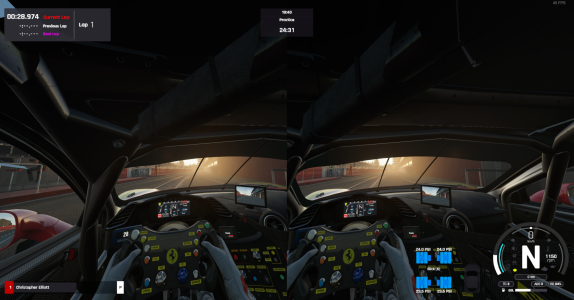
Testing Assetto Corsa EVO and The Current State of VR - I'm doing a series of tests to see where Assetto Corsa EVO stands in its current state when it comes to VR. I'll be comparing the Playstation VR2 running Steam VR and the Meta Quest 3 to get a baseline for future reference as development evolves.
When AC EVO was first released just a few weeks ago, most of us struggled to squeeze out even the minimum framerate, which was a bit of a pity for a first impression. To be totally honest, my expectations were through the roof - I had all my chips on the now mythical performance of the original Assetto Corsa from 2016. The original Assetto Corsa stunned the VR fans: it magically squeezed out ultra-performance while still looking amazing. But that was years ago. Standards are much higher now!
When it comes to performance, Automobilista 2 is, in my opinion, the current gold standard. AMS2 has god-level performance, graphical realism, and subtle post effects that cost very little-an incredibly immersive experience in the headset.
So, Assetto Corsa EVO has a lot to live up to in 2025 since the bar has been set very high, and VR performance will be the first epic boss battle it has to overcome!
On PC, not surprisingly, some titles run better on Quest 3, but most look way better on PSVR2, mainly because of the OLED displays. Sadly, performance is rarely better on the PSVR2, simply because it only runs through Valve's SteamVR.
But this isn't meant to be a shootout between two VR headsets. I just thought it would be cool to do some testing and compare the two on Assetto Corsa Evo to give some impressions of the visuals and the overall experience. Be aware that this write-up is part guide, part testing, and a big part, my opinion. So take it with a grain of salt
CPU AMD Ryzen 7800X3D (water-cooled / no overclock)
- An extremely capable CPU, no problem on most current titles in VR, so it's not throttling anything significant.
GPU Nvidia 3080ti
- In 2021, this GPU was almost top of the line. Today on the other hand, it's managing ok in VR, but nothing spectacular.
Probably the most interesting setting here is the "FOV- Tangent Multiplier." Changing this value results in a chopped-off viewport with rounded corners. Although some people justify this setting by saying it makes it look like a helmet cutout, I'm not a huge fan of this workaround. However, it does have a noticeable positive effect on performance.
For the sake of this test, I set it to a sensible 0.9;0.69. Nevertheless, if you want to try out a more extreme setting, another guide recommended 0.9;0.55. For me, that ended up looking too tron-like, claustrophobic, and squished.

Here the 72hz min refresh rate is perfect, if you can ignore that it's not 120hz and lacks that crispy snappyness!

The resolution scale is the biggest win for the PSVR2 on AC EVO when it comes to affecting performance. I've pulled this way down to 60% because my 3080ti can't handle any higher in AC EVO. Still, 64% is in line with the native resolution of the screens, but it's a compromise in the overall quality and image clarity.
Additionally, I advise everyone to turn off Motion Smoothing. As tempting as "smoothing" sounds, it's a truly abysmal compromise and will cause warped, janky assets inside the cockpit. For sim racing, it's a no-go!
For the Refresh Rate - I went with 90hz. No choice, really, since 120hz is far from sustainable at the moment.


The most noticeable toggle overall is Upscaling. For the Quest 3, it doesn't make a huge difference in the framerate or the look, but I still prefer it off. On the PSVR2, however, Upscaling is catastrophically bad beyond belief. Pre-Oculus-Rift-CV1 is bad, so a big pass on that one
Spoiler alert: There are some noticeable differences between the two headsets in terms of achieving a driveable experience. It becomes fairly obvious that AC EVO is better suited for Oculus/Quest 3, at least in terms of the available settings you can tweak that help performance. But the PSVR2 still has its amazing moments, so I'm not writing it off. Nothing beats OLED for richness and color range.
Sidenote: Images were taken on my iPhone simply to avoid any external process affecting performance. A couple of percentage points might be lost for running the Oculus mirror app since I had no other way to record the performance monitor, sadly.
The tests consist of practice and race sessions with fixed and accelerated times of day as well as clear skies and rainy conditions. By no means is this meant to be a representative test of every possible scenario. The scope of this article is limited to a simple comparison. I plan to go back and re-test when updates that affect VR performance will be released. For this specific test I decided on Imola with the Ferrari 488 Challenge EVO, mainly because I love that combo!


Overall, the tests speak for themselves. A mix of disappointment with visual potential, not very surprising results. You might be saying, "Hey, this makes no sense, Chris! AC EVO is in an early access state, so don't expect so much. Come on!" Although that's a valid point, for me, it's important to establish a personal baseline to see where we're at right now. From here, we can start to judge how steep the mountain is we're about to try and climb.
How much performance overhead will we need to end up with? The main question is: For those of us not on the very latest GPUs, will we be forced to fork out hundreds of bucks for a new one, all just to run AC EVO at an acceptable frame rate in VR? Or will AC EVO rival AMS2, and our current midlevel GPUs can live to fight another day?
With what we have right now, I see real promise visually. AC EVO could become the best VR sim racing experience out there. The lighting is sublime, and the overall color palette of the scene is rich without being garish and over-saturated. There's something very natural about Assetto Corsa EVO's graphics.
As far as settings go, I'm not picky about turning things down. The challenge is to get a smooth experience out of all the sims I own. That means the highest graphics settings are rarely achievable. With VR, perseverance is key when it comes to performance. I've managed to get a very enjoyable experience out of ACC - yes, Assetto Corsa Competizione in VR! I even squeezed enough VR performance out of EA Sports WRC! Both are titles based on Unreal Engine.
VR freaks like me mostly gave up on those two sims, but I persevered and even ran a whole league season in ACC. And I regularly participate in the WRC club races here at OverTake. So it ain't that bad if you can live with some visual mediocrity.
I truly hope AC EVO will overcome its VR performance struggles. Let's cross our fingers that AC EVO will achieve amazing VR performance on mid/low settings in the not too far off future. I recognize the limits of my 4-year-old GPU, but based on the above tests and impressions, I can't say we are anywhere near that at the moment...So keep pushing, Kunos; we are rooting for you!
What are your impressions of AC EVO in VR so far? Share your thoughts and impressions in the comments. If you have any tips or input on my testing by all means don't hesitate to chime in!
References used for settings:
Assetto Corsa Evo v0.1.1 - comprehensive VR set-up guide
Assetto Corsa EVO VR Guide | 10 FPS Boosting tips! for ACE VR
Assetto Corsa EVO Early Access VR
Assetto Corsa EVO is in early access. So, as it stands, the fact performance is tanking comes as no surprise. VR support is still less than ideal, but to be fair, it's never easy to run VR out of the box on any sim. VR almost always requires a very capable graphic card (GPU), preferably top of the line, and a well above-average processor (CPU), just to get a usable experience on most titles.When AC EVO was first released just a few weeks ago, most of us struggled to squeeze out even the minimum framerate, which was a bit of a pity for a first impression. To be totally honest, my expectations were through the roof - I had all my chips on the now mythical performance of the original Assetto Corsa from 2016. The original Assetto Corsa stunned the VR fans: it magically squeezed out ultra-performance while still looking amazing. But that was years ago. Standards are much higher now!
When it comes to performance, Automobilista 2 is, in my opinion, the current gold standard. AMS2 has god-level performance, graphical realism, and subtle post effects that cost very little-an incredibly immersive experience in the headset.
So, Assetto Corsa EVO has a lot to live up to in 2025 since the bar has been set very high, and VR performance will be the first epic boss battle it has to overcome!
Assetto Corsa EVO - Testing on the Playstation VR2 & Quest 3
A little while back, I grabbed a Playstation 5 PSVR2 specifically for Gran Turismo 7. And no, I don't regret it. The Playstation VR2 offers one of the best VR experiences in sim racing for the price. A few months later, Meta released the Quest 3, and I willingly jumped on the next hype train, mainly because my current PC headset was ageing. It turned out to result in a nice setup: one headset for PC and one for PS5. That is until Sony released the now infamous PC adapter for the PSVR2 at an extra cost. Yep, you guessed it, I caved again for the hype train...On PC, not surprisingly, some titles run better on Quest 3, but most look way better on PSVR2, mainly because of the OLED displays. Sadly, performance is rarely better on the PSVR2, simply because it only runs through Valve's SteamVR.
But this isn't meant to be a shootout between two VR headsets. I just thought it would be cool to do some testing and compare the two on Assetto Corsa Evo to give some impressions of the visuals and the overall experience. Be aware that this write-up is part guide, part testing, and a big part, my opinion. So take it with a grain of salt
Test setup:
PC Spec:CPU AMD Ryzen 7800X3D (water-cooled / no overclock)
- An extremely capable CPU, no problem on most current titles in VR, so it's not throttling anything significant.
GPU Nvidia 3080ti
- In 2021, this GPU was almost top of the line. Today on the other hand, it's managing ok in VR, but nothing spectacular.
PC and App Settings:
Disclaimer: The settings here were collated from other guides, which I cited below. I take no credit. I simply used what worked best for me.Quest 3 - Oculus Debug Tool Settings
If you can't find it, it's located in - C:\Program Files\Oculus\Support\oculus-diagnostics\OculusDebugTool.exeProbably the most interesting setting here is the "FOV- Tangent Multiplier." Changing this value results in a chopped-off viewport with rounded corners. Although some people justify this setting by saying it makes it look like a helmet cutout, I'm not a huge fan of this workaround. However, it does have a noticeable positive effect on performance.
For the sake of this test, I set it to a sensible 0.9;0.69. Nevertheless, if you want to try out a more extreme setting, another guide recommended 0.9;0.55. For me, that ended up looking too tron-like, claustrophobic, and squished.
Quest 3 - Oculus Link
The only thing to really set here is the Refresh rate - 72hzHere the 72hz min refresh rate is perfect, if you can ignore that it's not 120hz and lacks that crispy snappyness!
PSVR2 - Steam VR
One of the main issues with the PSVR2 is its lack of settings. The Quest 3 combined with the Oculus Debug Tool is just way more flexible. But alas, we use what we have, and that's just SteamVR.The resolution scale is the biggest win for the PSVR2 on AC EVO when it comes to affecting performance. I've pulled this way down to 60% because my 3080ti can't handle any higher in AC EVO. Still, 64% is in line with the native resolution of the screens, but it's a compromise in the overall quality and image clarity.
Additionally, I advise everyone to turn off Motion Smoothing. As tempting as "smoothing" sounds, it's a truly abysmal compromise and will cause warped, janky assets inside the cockpit. For sim racing, it's a no-go!
For the Refresh Rate - I went with 90hz. No choice, really, since 120hz is far from sustainable at the moment.
NVIDIA Control Panel Settings
I think many of these settings are actually not very important. I have never seen any huge gains from Nvidia settings, but I played with them anyway, following other users' recommendations. One big exception is "Virtual reality pre-rendered frames", which needs to be set to 1.Assetto Corsa EVO In-Game Graphics Settings:
No surprise here. Almost everything is set to low, either because it affects performance or setting it higher I couldn't see any difference in visuals or performance. So, the best decision is to just set most parameters to the lowest level or OFF. With exception of Anisotropic on Ultra and Medium Texture Pool Size, I tried these settings at different levels and there was very little impact on performance, bit it looks a bit better on the curbs, so a small trade off.The most noticeable toggle overall is Upscaling. For the Quest 3, it doesn't make a huge difference in the framerate or the look, but I still prefer it off. On the PSVR2, however, Upscaling is catastrophically bad beyond belief. Pre-Oculus-Rift-CV1 is bad, so a big pass on that one
Finally - Now to my impressions and testing!
Assetto Corsa Evo Version v 0.1.5Spoiler alert: There are some noticeable differences between the two headsets in terms of achieving a driveable experience. It becomes fairly obvious that AC EVO is better suited for Oculus/Quest 3, at least in terms of the available settings you can tweak that help performance. But the PSVR2 still has its amazing moments, so I'm not writing it off. Nothing beats OLED for richness and color range.
Sidenote: Images were taken on my iPhone simply to avoid any external process affecting performance. A couple of percentage points might be lost for running the Oculus mirror app since I had no other way to record the performance monitor, sadly.
The tests consist of practice and race sessions with fixed and accelerated times of day as well as clear skies and rainy conditions. By no means is this meant to be a representative test of every possible scenario. The scope of this article is limited to a simple comparison. I plan to go back and re-test when updates that affect VR performance will be released. For this specific test I decided on Imola with the Ferrari 488 Challenge EVO, mainly because I love that combo!
Practice Sessions
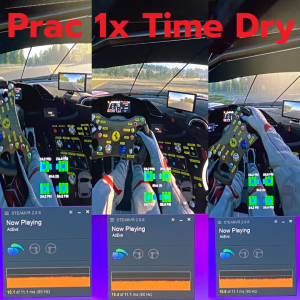
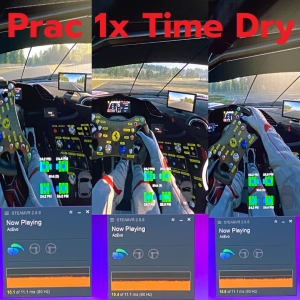
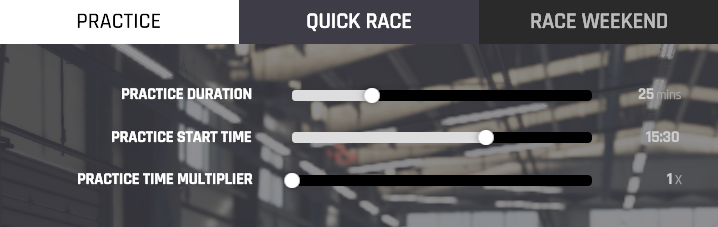
Test 1: Practice Clear 1x time scale Time of Day 15:30 - PSVR2
Observations: Here, you can see the frame rate is stable around 16ms but above 11ms. Ideally, it should be well under, but it's smooth, with almost no freezes or hiccups for the most part.Quest 3
Observations: On Quest 3 in the performance summary, we can see there's a tiny bit of Performance Headroom between 10-20% max. Overall, it's very stable, even with a few thousand dropped frames.Test 2 - Practice Clear 48x time scale Start Time of Day 15:30
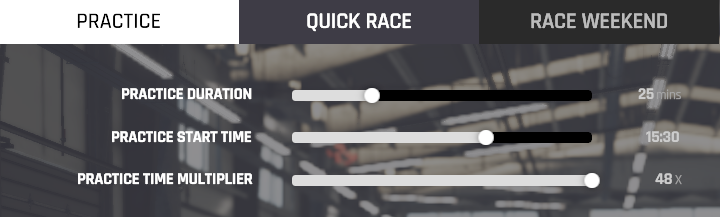
PSVR2
Observations: On the PSVR2, again, frames stay stable but well above 11ms all throughout the lap, even as it gets darker and headlights come on. However, there are times when dropped frames are starting to cause lags and microfreezes. See the middle image.Quest 3
Observations: Here we get a maximum of 12% Performance Headroom but it quickly dips lower in most situations, this doesn't affect the overall smoothness, frame rate stays at solidly at 72hz.Test 3 - Practice Rainy 1x time scale Start Time of Day 15:30
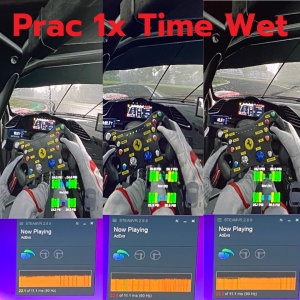
PSVR2
Observations: Wet performance alone on track is already quite a bit lower than dry conditions averaging in the 20ms, dropped frames start to cause freezes and stuttering.Quest 3
Observations: Wet performance alone on the track for the Quest 3 stay at a reasonable framerate, quite a bit smoother than the PSVR2, with less notifiable stuttering overall.Race Sessions
For the dry race with 48X time acceleration, I decided to split the sessions into 2 start times, one where the sun sets in one lap and another where the sun rises in one lap, 18:30 (6:30PM) and 4:30AM, respectively. In the wet, I set it to a fixed 1x 15:30 (3:30PM) with no time acceleration. A total of 9 cars, including me, and I put myself 5th on the grid to try and stay close to the pack throughout the lap.Test 4 - Race Clear 1x time scale Time of Day 15:30
PSVR2
Observations: Around other cars the framerate tank and causes some serious stuttering, once the AI cars are spread out this gets much better, which is no surprise.Quest 3
Observations: Here, we start to see some occasional dips in the framerate down in the 60hz range, but only sporadically. Overall a better driving experience on the Quest around other cars.Test 5 - Race Clear 48x time scale Start Time of Day 18:30 (sunset) and 4:30 (sunrise)
PSVR2
Observations: Not seeing a marked difference to the static time; however, as expected, headlight conditions are asking for more resources, frame-time jumps a couple of points into the 20s, and more dropped framesQuest 3
Observations: Here the Quest starts to struggle oddly, framerate drops into the 50s sporadically and when there's an abrupt drops in the framerate graph, see middle image, the image freezes. The freezes are less frequent than on the PSVR2, but they are more extreme, lasting almost half a second.Test 6 - Race Rainy 1x time scale Time of Day 15:30
PSVR2
Observations: Here the PSVR2 really struggles, the frametime is solidly in the 20s to mid 20s, with clusters of dropped frames making it a stomach turning adventure!Quest 3
Observations: Similar to the night to day transitions the Quest 3 starts to dip in places and even gets into the 40 range frame-rate. Overall, it's way less jarring than on the PSVR2, but by no means ideal.Conclusion:
What are my take-aways from Assetto Corsa EVO's VR performance at this very early access stage of development?Overall, the tests speak for themselves. A mix of disappointment with visual potential, not very surprising results. You might be saying, "Hey, this makes no sense, Chris! AC EVO is in an early access state, so don't expect so much. Come on!" Although that's a valid point, for me, it's important to establish a personal baseline to see where we're at right now. From here, we can start to judge how steep the mountain is we're about to try and climb.
How much performance overhead will we need to end up with? The main question is: For those of us not on the very latest GPUs, will we be forced to fork out hundreds of bucks for a new one, all just to run AC EVO at an acceptable frame rate in VR? Or will AC EVO rival AMS2, and our current midlevel GPUs can live to fight another day?
With what we have right now, I see real promise visually. AC EVO could become the best VR sim racing experience out there. The lighting is sublime, and the overall color palette of the scene is rich without being garish and over-saturated. There's something very natural about Assetto Corsa EVO's graphics.
As far as settings go, I'm not picky about turning things down. The challenge is to get a smooth experience out of all the sims I own. That means the highest graphics settings are rarely achievable. With VR, perseverance is key when it comes to performance. I've managed to get a very enjoyable experience out of ACC - yes, Assetto Corsa Competizione in VR! I even squeezed enough VR performance out of EA Sports WRC! Both are titles based on Unreal Engine.
VR freaks like me mostly gave up on those two sims, but I persevered and even ran a whole league season in ACC. And I regularly participate in the WRC club races here at OverTake. So it ain't that bad if you can live with some visual mediocrity.
I truly hope AC EVO will overcome its VR performance struggles. Let's cross our fingers that AC EVO will achieve amazing VR performance on mid/low settings in the not too far off future. I recognize the limits of my 4-year-old GPU, but based on the above tests and impressions, I can't say we are anywhere near that at the moment...So keep pushing, Kunos; we are rooting for you!
What are your impressions of AC EVO in VR so far? Share your thoughts and impressions in the comments. If you have any tips or input on my testing by all means don't hesitate to chime in!
References used for settings:
Assetto Corsa Evo v0.1.1 - comprehensive VR set-up guide
Assetto Corsa EVO VR Guide | 10 FPS Boosting tips! for ACE VR