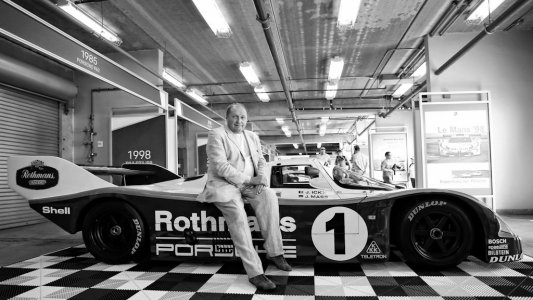
German motorsport has lost one of its greats: On May 4, 2025, Le Mans champion and Grand Prix winner Jochen Mass passed away. The Bavarian will be remembered for his outstanding career.
"Willkommen im malerischen Monte Carlo zum Monaco Grand Prix."
("Welcome to picturesque Monte Carlo for the Monaco Grand Prix.")
Delivered in a rather stoic tone, this and plenty of similar quotes referring to the entirety of the 1995 Formula One calendar were my first touch points of sorts with Jochen Mass. A color commentator for German broadcaster RTL from 1993 to 1997, he was the commentator for the German version of Formula One on PlayStation, a game that shaped my childhood and was a big part of my love for motorsport and sim racing.
Personally, I do not remember him from TV, but because of this game, his voice has been etched into my mind forever. Unlike Murray Walker, as I would come to learn later on, Mass' style on the microphone was rather calm and matter-of-factly. Even if you crashed into the back of another car, his delivery of "Schauen Sie sich das an! Unglaublich!" ("Look at this! Unbelievable!") sounded a bit casual.
That's not to say that there were no occasions of him becoming excited, but he certainly also did not sugarcoat things - like when he remembered Porsche teammate Stefan Bellof's fatal accident at Spa in 1985 in an interview with German racing news outlet Motorsport Total (translated):
"It was a maneuver that was way too optimistic, and risky at this spot, too. You cannot fault Ickx for it. The crash was on Stefan - unfortunately."

Mass (right) with Porsche Chief Research & Development Officer Helmuth Bott (left) and Dr. Wolfgang Porsche at Le Mans in 1982. Image: Porsche Newsroom
What followed were a few of the usual rungs on the motorsport ladder of the time: European Formula Super Vee, British Formula 3, Formula 2. Mass also showed his craft in touring cars, entering a handful of races in the British Saloon Car Championship.
Eventually, he made his F1 debut at the 1973 British Grand Prix for Surtees, for whom he was also racing in F2 at the time. Retiring on lap 1 already as a casualty of the pileup at the end of lap 1 caused by Jody Scheckter, which eliminated nine cars, Mass would follow up with a strong seventh-place finish at the German Grand Prix two weeks later.
Scheduled for 75 laps, the race was halted after only 29. Embass Hill's Rolf Stommelen had crashed heavily after his rear wing failed, clearing the armco and killing a fireman, a spectator and two photographers. Stommelen survived with a broken leg, a broken wrist and cracked ribs.
As the race was not run to at least 60% of its scheduled distance, half points were awarded, which meant Mass netted 4.5 points for what would be his only win. This would also be the only time to date that a woman would score in an F1 race, as Lella Lombardi was classified in sixth, awarding her half a point.
Racing was still inherently dangerous in those days, and it would not be the final time Mass and his fellow drivers would be reminded of this. After his McLaren tenure ended in 1977, he switched to the German ATS team while also giving the 24 Hours of Le Mans a shot for the first time in a works Porsche, sharing a car with Jacky Ickx and Henri Pescarolo. The trio had to retire in the race's 20th hour with gearbox issues.
Qualifying for the 1982 Belgian Grand Prix at Zolder was almost over. Mass was already slowing down after a flying lap of his own and approaching the Terlamenbocht, the first turn of the double right-hander at the back of the circuit. This is when he spotted Gilles Villeneuve's Ferrari in his rear view mirrors, the Canadian on a flyer himself, trying to one-up teammate-turned-rival Didier Pironi.
Mass move over to the right to clear the racing line for Villeneuve - who had just moved the same way to get past Mass. The Ferrari launched over the March, and Gilles did not stand a chance in the ensuing crash.
The fatal accident left Mass feeling guilty, as he had reportedly known Villeneuve quite well. Despite this, he carried on - as racing drivers did back then. But not for too much longer, at least not in Formula One.
"Why did I survive this?", the German would later say about his racing days as a whole. This question that no one can really answer was no doubt heavily influenced by these events. Realizing that he may not have a proverbial horseshoe tucked in his back pocket every time he stepped into an F1 car, Mass retired from single seaters after the Paul Ricard crash.
That was not the end of his racing career, however. Instead, Mass made the switch to sportscars, competing in Porsche's Group C prototypes from 1982 onwards. This time would prove to be immensely successful, but it was not until Mass switched to Sauber-Mercedes that he would become a Le Mans winner.

Mass behind the wheel of a Sauber-Mercedes C9 at Le Mans in 1989, a race he would go on to win. Image: Mercedes-Benz Media
Together with Manuel Reuter and Stanley Dickens, Mass took the victory five laps ahead of another Sauber C9. It was the end of an era, too - Dickens/Mass/Reuter was the final trio to win the 24 Hours of Le Mans with the uninterrupted Hunaudières Straight as part of the layout. The Sauber-Mercedes cars were reportedly reaching 400 kph on the straights that year.
Following this triumph, Mass would take on Le Mans two more times, but did not finish in either 1991 or 1995.
However, he was still instrumental to the Sauber-Mercedes sportscar effort - and also a mentor to not one, but three future Formula One drivers, including one of the greatest ever.
Following a tie with Heinz-Harald Frentzen for second in the German Formula 3 championship in 1989, just one point behind Karl Wendlinger, Michael Schumacher as well as Frentzen and Wendlinger were promoted to the Mercedes junior team.

Mass (left) with the Mercedes junior team at Paul Ricard: (from left to right) Karl Wendlinger, Heinz-Harald Frentzen, Michael Schumacher. Image: Mercedes-Benz Media
"Michael watched me very closely. I had also spurred on his ambition without having to say much. I was 43, Michael was 21, and he would never have accepted being slower than someone twice his age", Mass remembered in a column for Cologne-based newspaper Express in 2020.
All three drivers made it to Formula One, Schumacher already in 1991, Wendlinger in 1993, and Frentzen in 1994. While Schumacher went on to become a seven-time World Champion, Frentzen almost took the title in 1999, and Wendlinger's career was derailed by his scary crash in Monaco in 1994 that left him in a coma. He would recover and go on to have a respectable career in sportscars, however.
Interestingly, it was Schumacher who made Mass consider retirement from racing altogether, as he told Express: "Of course I knew that a new era was beginning and mine was coming to an end.At the last race of the 1991 season in Japan, I thought to myself: It's about time I stopped. Michael was running rings around us old guys. My god, did he fly around the track!"
After that, Mass was still around cars and motorsport, driving classic cars at historic racing events, particularly for Mercedes.
It was this connection to automotive and racing history that led to my only encounter with Jochen - if you want to call it that. Working at one of the exhibition booths at Retro Classics Bavaria in 2021, I spotted a familiar face strolling through - Mass had taken interest in a Porsche 718 Cayman GT4 wrapped in a Boss pinstripe livery, similar to that of Obermaier Racing's Porsche 956 as it ran at the 1983 24 Hours of Le Mans.
We didn't really interact beside a glance or two, but I feel like Jochen's appearance there kind of summarized him well. Calm, collected, no fanfare - but you could still somehow tell that cars and racing were his passion, something that he still loved all these years after his active career had ended.
On May 4, 2025, Jochen Mass passed away due to complications from a stroke he had suffered in February. He was 78 years old.
Rest in peace.
Feel free to share your favorite memories, quotes or stories of Jochen Mass in the comments below!
"Willkommen im malerischen Monte Carlo zum Monaco Grand Prix."
("Welcome to picturesque Monte Carlo for the Monaco Grand Prix.")
Delivered in a rather stoic tone, this and plenty of similar quotes referring to the entirety of the 1995 Formula One calendar were my first touch points of sorts with Jochen Mass. A color commentator for German broadcaster RTL from 1993 to 1997, he was the commentator for the German version of Formula One on PlayStation, a game that shaped my childhood and was a big part of my love for motorsport and sim racing.
Personally, I do not remember him from TV, but because of this game, his voice has been etched into my mind forever. Unlike Murray Walker, as I would come to learn later on, Mass' style on the microphone was rather calm and matter-of-factly. Even if you crashed into the back of another car, his delivery of "Schauen Sie sich das an! Unglaublich!" ("Look at this! Unbelievable!") sounded a bit casual.
That's not to say that there were no occasions of him becoming excited, but he certainly also did not sugarcoat things - like when he remembered Porsche teammate Stefan Bellof's fatal accident at Spa in 1985 in an interview with German racing news outlet Motorsport Total (translated):
"It was a maneuver that was way too optimistic, and risky at this spot, too. You cannot fault Ickx for it. The crash was on Stefan - unfortunately."
Mass (right) with Porsche Chief Research & Development Officer Helmuth Bott (left) and Dr. Wolfgang Porsche at Le Mans in 1982. Image: Porsche Newsroom
Navy To Nordschleife
At this point, Mass' Formula One days were already behind him. But let's start at the beginning. Born in 1946 in Dorfen, Bavaria, Germany, Mass caught the racing bug when watching a hillclimb event, leading to him quitting the German Merchant Navy, where he had worked on ships. An apprenticeship at an Alfa-Romeo dealership led to his first racing experiences as the owner fielded cars in a few events, and his talents were quickly recognized.What followed were a few of the usual rungs on the motorsport ladder of the time: European Formula Super Vee, British Formula 3, Formula 2. Mass also showed his craft in touring cars, entering a handful of races in the British Saloon Car Championship.
Eventually, he made his F1 debut at the 1973 British Grand Prix for Surtees, for whom he was also racing in F2 at the time. Retiring on lap 1 already as a casualty of the pileup at the end of lap 1 caused by Jody Scheckter, which eliminated nine cars, Mass would follow up with a strong seventh-place finish at the German Grand Prix two weeks later.
A Win In Tragic Circumstances
After falling out with team boss and 1964 F1 World Champion John Surtees, Mass switched to McLaren in 1974 for the final two races of the season. He would stay with the team for the following year, partnering Emerson Fittipaldi. At the Spanish Grand Prix, he even got his maiden Grand Prix win - but there was no reason for celebration.Scheduled for 75 laps, the race was halted after only 29. Embass Hill's Rolf Stommelen had crashed heavily after his rear wing failed, clearing the armco and killing a fireman, a spectator and two photographers. Stommelen survived with a broken leg, a broken wrist and cracked ribs.
As the race was not run to at least 60% of its scheduled distance, half points were awarded, which meant Mass netted 4.5 points for what would be his only win. This would also be the only time to date that a woman would score in an F1 race, as Lella Lombardi was classified in sixth, awarding her half a point.
Racing was still inherently dangerous in those days, and it would not be the final time Mass and his fellow drivers would be reminded of this. After his McLaren tenure ended in 1977, he switched to the German ATS team while also giving the 24 Hours of Le Mans a shot for the first time in a works Porsche, sharing a car with Jacky Ickx and Henri Pescarolo. The trio had to retire in the race's 20th hour with gearbox issues.
Surrounded By Danger - And Sometimes In The Middle Of It
A testing crash resulting in a broken leg was another reminder of the dangers of racing, and for 1979, Mass moved on to Arrows, which is where he would stay until the end of 1981 before getting a seat with March for the following year. His final season in 1982 was marred by tragedy, however, and Mass was right in the middle of it.Qualifying for the 1982 Belgian Grand Prix at Zolder was almost over. Mass was already slowing down after a flying lap of his own and approaching the Terlamenbocht, the first turn of the double right-hander at the back of the circuit. This is when he spotted Gilles Villeneuve's Ferrari in his rear view mirrors, the Canadian on a flyer himself, trying to one-up teammate-turned-rival Didier Pironi.
Mass move over to the right to clear the racing line for Villeneuve - who had just moved the same way to get past Mass. The Ferrari launched over the March, and Gilles did not stand a chance in the ensuing crash.
The fatal accident left Mass feeling guilty, as he had reportedly known Villeneuve quite well. Despite this, he carried on - as racing drivers did back then. But not for too much longer, at least not in Formula One.
"Why did I survive this?"
Almost three months after the Belgian Grand Prix weekend, Mass and Mauro Baldi were involved in a frightening accident at the French Grand Prix. Tangling at Signes, the fast right-hander following the long Mistral Straight, Mass went through the catch fencing and over the barrier into a spectator area. Miraculously, everyone made it out alive, though there were spectator injuries, and Mass himself suffered burns on his hands."Why did I survive this?", the German would later say about his racing days as a whole. This question that no one can really answer was no doubt heavily influenced by these events. Realizing that he may not have a proverbial horseshoe tucked in his back pocket every time he stepped into an F1 car, Mass retired from single seaters after the Paul Ricard crash.
That was not the end of his racing career, however. Instead, Mass made the switch to sportscars, competing in Porsche's Group C prototypes from 1982 onwards. This time would prove to be immensely successful, but it was not until Mass switched to Sauber-Mercedes that he would become a Le Mans winner.
Mass behind the wheel of a Sauber-Mercedes C9 at Le Mans in 1989, a race he would go on to win. Image: Mercedes-Benz Media
Le Mans Winner & Mercedes Mentor
Having taken five WSC victories in the iconic Sauber C9 in 1988, Mass continued his strong form in 1989, finishing on the podium every time he saw the checkered flag, including four wins. Le Mans did not count towards the World Sportscar Championship that year - had it been part of the calendar, it would have been victory number 5.Together with Manuel Reuter and Stanley Dickens, Mass took the victory five laps ahead of another Sauber C9. It was the end of an era, too - Dickens/Mass/Reuter was the final trio to win the 24 Hours of Le Mans with the uninterrupted Hunaudières Straight as part of the layout. The Sauber-Mercedes cars were reportedly reaching 400 kph on the straights that year.
Following this triumph, Mass would take on Le Mans two more times, but did not finish in either 1991 or 1995.
However, he was still instrumental to the Sauber-Mercedes sportscar effort - and also a mentor to not one, but three future Formula One drivers, including one of the greatest ever.
Following a tie with Heinz-Harald Frentzen for second in the German Formula 3 championship in 1989, just one point behind Karl Wendlinger, Michael Schumacher as well as Frentzen and Wendlinger were promoted to the Mercedes junior team.
Mass (left) with the Mercedes junior team at Paul Ricard: (from left to right) Karl Wendlinger, Heinz-Harald Frentzen, Michael Schumacher. Image: Mercedes-Benz Media
Motivating Michael Schumacher
In 1990 and 1991, the three up-and-comers would be mentored by Mass as well as Baldi and Jean-Louis Schlesser as the veterans of the team."Michael watched me very closely. I had also spurred on his ambition without having to say much. I was 43, Michael was 21, and he would never have accepted being slower than someone twice his age", Mass remembered in a column for Cologne-based newspaper Express in 2020.
All three drivers made it to Formula One, Schumacher already in 1991, Wendlinger in 1993, and Frentzen in 1994. While Schumacher went on to become a seven-time World Champion, Frentzen almost took the title in 1999, and Wendlinger's career was derailed by his scary crash in Monaco in 1994 that left him in a coma. He would recover and go on to have a respectable career in sportscars, however.
Interestingly, it was Schumacher who made Mass consider retirement from racing altogether, as he told Express: "Of course I knew that a new era was beginning and mine was coming to an end.At the last race of the 1991 season in Japan, I thought to myself: It's about time I stopped. Michael was running rings around us old guys. My god, did he fly around the track!"
Not Racing Anymore, But Still Behind The Wheel
Only occasionally did Jochen do that after the 1991 season. In 1995, he attempted Le Mans one more time, sharing a McLaren F1 GTR with John Nielsen and Thomas Bscher but retiring after 131 laps. And in 1999, he ran an Audi TT Quattro at the Nürburgring 24 Hours with Josef Müller and Michael Ruess. The team was classified in 98th.After that, Mass was still around cars and motorsport, driving classic cars at historic racing events, particularly for Mercedes.
It was this connection to automotive and racing history that led to my only encounter with Jochen - if you want to call it that. Working at one of the exhibition booths at Retro Classics Bavaria in 2021, I spotted a familiar face strolling through - Mass had taken interest in a Porsche 718 Cayman GT4 wrapped in a Boss pinstripe livery, similar to that of Obermaier Racing's Porsche 956 as it ran at the 1983 24 Hours of Le Mans.
We didn't really interact beside a glance or two, but I feel like Jochen's appearance there kind of summarized him well. Calm, collected, no fanfare - but you could still somehow tell that cars and racing were his passion, something that he still loved all these years after his active career had ended.
On May 4, 2025, Jochen Mass passed away due to complications from a stroke he had suffered in February. He was 78 years old.
Rest in peace.
Feel free to share your favorite memories, quotes or stories of Jochen Mass in the comments below!