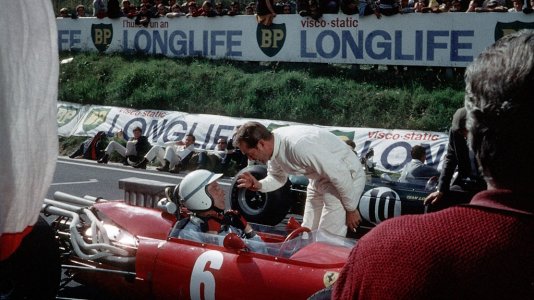
The 2025 Formula One season is underway, a tie-in of the upcoming F1 movie with F1 25 has been announced - so it's time to look back at perhaps the definitive F1 movie - 1966's Grand Prix, directed by John Frankenheimer.
Image: Robert Huhardeaux via Wikimedia Commons, available for redistribution under the CC BY-SA 2.0 deed
With how diverse sim racing is these days, it is rare that sim racers universally agree on something. There are, however, certain things that seem to be appreciated by the vast majority, if not everyone in the community: V10-powered F1 cars, for example. Group C sportscars of the 1980s as well, or the Nürburgring-Nordschleife, which is called for in almost every sim that does not have it.
And then, there is the 1966 to 1967 period in Formula One. Not really long enough to call it an era, it is still regarded as one of the purest of the sport - engines had returned to power for 1966, cars were still painted in their nation's racing colors, and wings had not yet sprouted on them. F1 was fast, dangerous and gentlemanly at the time.
This is also what drove developer Papyrus to pick the 1967 season for Grand Prix Legends, which has gone on to become a cult classic since its 1998 release. Coupled with all-time greats like Jim Clark, Graham Hill, Jackie Stewart, Dan Gurney, Jack Brabham, Jochen Rindt and many more on the grid, the sim played its part in the fond view of the period many sim racers still have today.
It is no coincidence that the Lotus 49 of that year, driven by Clark and Hill, is almost everywhere you look in sim racing, for example. But this is about a movie, of course, so let's get to the point - Grand Prix. Released in 1966, it still stands the test of time almost 60 years later, and it also played its part in popularizing the period of F1 it portrayed for decades to come.
Remember, this was a time when the most racing you would see would be grainy black-and-white clips on a tiny TV screen or photos in newspapers, unless you went to the tracks themselves. A far cry from today's coverage, showing practically every second of every Grand Prix weekend from every conceivable angle and an abundance of data to look at.
Being able to see the action in full and at times through the eyes of the drivers themselves was revolutionary, and it captured the atmosphere of the mid-to-late 60s Grand Prix circus perfectly. This was no easy feat, mind you, as onboard cameras - a miniscule thing by today's standards - were big, heavy things that were difficult to attach to a single-seater.
Mostly, they were Formula 3 cars dressed up to look like F1 cars, although real racing footage was used as well, which is why some of the protagonists' helmet designs match those of real F1 drivers of the time. There are four main characters in Grand Prix, and compared to 1971's Le Mans starring Steve McQueen, they actually have actual plots that are told in the movie - otherwise, the run time of a whopping 176 minutes would probably have been difficult to justify, anyway.
With four main characters, there are four plots that are all intertwined: Two-time World Champion Jean-Pierre Sarti (Montand), racing for Ferrari and close to retiring from F1. American Pete Aron (Garner), who finds sanctuary at the Yamura team (a fictionalized version of Honda) after being axed from Jordan-BRM for supposedly causing a crash with teammate Scott Stoddard (Bedford) at the Monaco Grand Prix.
In reality, the crash is caused by technical problems with Aron's gearbox, leading to him crashing into the harbor, while Stoddard hits the barriers, then ramps off a rocky slope by the track. Aron escapes the wreck uninjured, but Stoddard is bloodied and battered badly in his car.
An injured Stoddard is essentially written off as a driver by team owner Jeff Jordan (Jack Watson), but his wife Pat (Walter) knows that he will find a way to make a comeback despite hoping that they will have "some peace in our lives now" - which she is not willing to wait for any longer, leaving Stoddard. Later, she finds herself getting close to Aron for a short while.
Stoddard, meanwhile, recovers, but still battles injuries from the Monaco crash, as well as the pressure put on him by his family because of his late brother Roger's successes - on top of his marriage troubles, that is. The Monaco GP he crashed out of was won by Sarti, who finds himself falling for journalist Louise Frederickson (Saint), despite being married himself.
Sarti's teammate Nino Barlini (Sabàto) is regarded as a promising rookie. A mutiple former motorcycle World Champion (an interesting parallel to John Surtees, who was racing for Honda in F1 at the time), he manages to make the switch to cars well. A charismatic driver, he soon finds himself attracted to Lisa (Hardy), who he meets at a discotheque after the race in Monte Carlo.

James Garner learned how to drive race cars in order to shoot his own racing scenes in Grand Prix. Image: Robert Huhardeaux via Wikimedia Commons, available for redistribution under the CC BY-SA 2.0 deed
The film follows all four men's fortunes over the course of the season, in addition to their love lifes off the track, highlighting not only what they experience in Formula One, but also the difficulties their chosen profession can cause in their personal lives. Conversely, it also shows the challenges of the women that are by their sides - on one hand, there is the often glamorous globetrotter lifestyle that comes with racing, and on the other, there is the harsh reality of dealing with the inherent danger of the sport and its consequences.
As the championship battle unfolds and eventually comes to a head at the final race of the season in Monza, Sarti crashes on the oval part of the circuit (which was not actually used in F1 at the time anymore) trying to avoid debris of another car, throwing him clear of the Ferrari and into the trees lining the track, killing him.
In the end, this means that Aron as the winner of the race wins the World Championship as well, as the other Ferrari of Barlini's is withdrawn out of respect - a common procedure in the early years of Grand Prix racing. While he and the Yamura team are overjoyed initially, Sarti's death overshadows the celebratory mood.
What makes Grand Prix stand out to us sim racers and motorsport fans alike is, of course, its racing cinematography. As the title of this review already gives away, there simply wasn't anything like it, and the fact that the racing scenes still hold up - for the most part - even today is a true testament to how well they have been shot.
Picture quality is an important factor in this: Grand Prix was shot in Super Panavision 70, leading to impressive color and clarity. As a result, the BluRay version of the film in particular still looks great today, even on bigscreen TVs.
Therefore, the film serves as a window into an era of F1 racing that could not be replicated the same way today. Most of the material has been filmed at the actual events, capturing the environments exactly as they were in 1966.
The dangerous side of racing is presented rather matter-of-factly - even Sarti's fatal crash is shown without much fanfare, no dramatic music or slow-motion shots. Rapid changes of camera angles show the viewer what happens and why Sarti crashes, what happens to him, but that's mostly it.
The race continues as his body is retrieved, Ferrari retires Barlini's car, and Sarti is taken to the paddock on a stretcher where he is put into an ambulance. Both his wife and Louise are present, and while the former is simply in shock, the latter is hysterical, breaking down with Sarti's blood on her hands as the ambulance pulls away.
Sarti's death is then mentioned via the tracks PA system as Aron and Stoddard are stood on the podium, their expressions showing how heavily the news weigh on them, providing another example of the thin line between glory and the grim reality of the sport.
Another example of this matter-of-fact approach can be seen during the Belgian Grand Prix at Spa-Francorchamps, still using the fearsome full-throttle layout on public roads. As rain starts to fall, Sarti loses control at stavelot due to his suspension failing, and crashes into the control tower located on the outside of the turn.
Two boys had hopped the fence there to get a better view of the cars screaming by, and while Sarti is lifted from his wrecked Ferrari injured, but mostly okay, it is revealed that both boys have died in the crash. Again, no fanfare, just a shot of them in a ditch. The movie then immediately cuts to the race's conclusion and Aron's celebrations with the Yamura team.
In 2025, the movie is a way to keep this era (now I did call it an era - oh well!) of Grand Prix racing alive, much more so than old black-and-white clips and photos. While the story-focused scenes in between races can feel like they drag on quite a bit, it does well to show that it was not easy to be the significant other of a racing driver in those times - something that Steve McQueen's Le Mans would later also include, even though it barely features any story aside from the racing.
To conclude with a bit of trivia: Le Mans is also the reason why there is no footage from the 1966 German Grand Prix. McQueen and director John Sturges had initially planned on shooting a similar film and had an exclusivity contract with the Nürburgring, meaning everything that Frankenheimer shot there for Grand Prix had to be handed over to Sturges.
A shame in retrospect, because seeing The Green Hell in all its 1966 glory and in high quality would have been simply spectacular if the other racing scenes are any indication.
 "As the self-declared resident movie fanatic on the OverTake team, I elected to hand this one over to Yannik as I am ashamed to admit, I have not seen the Grand Prix movie. Yes, I know, the sacrilege.
But if it is anything like Yannik says, I am looking forward to doing so eventually. It is true that this movie really is the genesis of all motorsport movies, every one of them can trace their roots back to Grand Prix.
With how expensive making a movie about racing can be and how it really is still a niche meaning little guarantee of a high return at the box office. But the journey of a thousand miles begins with the single step, and the Grand Prix movie took that first step to provide us motorsport fans a chance to see what we love portrayed on the silver screen, and we should be grateful for that."
Which other motorsport movies should we review and what do you think of Grand Prix? Let us know in the comments below, and join the discussion on our forums!
Image: Robert Huhardeaux via Wikimedia Commons, available for redistribution under the CC BY-SA 2.0 deed
With how diverse sim racing is these days, it is rare that sim racers universally agree on something. There are, however, certain things that seem to be appreciated by the vast majority, if not everyone in the community: V10-powered F1 cars, for example. Group C sportscars of the 1980s as well, or the Nürburgring-Nordschleife, which is called for in almost every sim that does not have it.
And then, there is the 1966 to 1967 period in Formula One. Not really long enough to call it an era, it is still regarded as one of the purest of the sport - engines had returned to power for 1966, cars were still painted in their nation's racing colors, and wings had not yet sprouted on them. F1 was fast, dangerous and gentlemanly at the time.
This is also what drove developer Papyrus to pick the 1967 season for Grand Prix Legends, which has gone on to become a cult classic since its 1998 release. Coupled with all-time greats like Jim Clark, Graham Hill, Jackie Stewart, Dan Gurney, Jack Brabham, Jochen Rindt and many more on the grid, the sim played its part in the fond view of the period many sim racers still have today.
It is no coincidence that the Lotus 49 of that year, driven by Clark and Hill, is almost everywhere you look in sim racing, for example. But this is about a movie, of course, so let's get to the point - Grand Prix. Released in 1966, it still stands the test of time almost 60 years later, and it also played its part in popularizing the period of F1 it portrayed for decades to come.
Star-Studded Cast & F1 Driver Cameos
The film directed by John Frankenheimer and starring Jamers Garner, Eva Marie Saint, Yves Montand, Brian Bedford, Jessica Walter, Françoise Hardy and Antonio Sabàto - a star-studded cast for the time - won three Oscars for essentially taking the viewer right onto the racetrack. Real racing scenes, cameo appearances of Formula One stars of the time, and its stunning visuals meant there was nothing else like it.Remember, this was a time when the most racing you would see would be grainy black-and-white clips on a tiny TV screen or photos in newspapers, unless you went to the tracks themselves. A far cry from today's coverage, showing practically every second of every Grand Prix weekend from every conceivable angle and an abundance of data to look at.
Being able to see the action in full and at times through the eyes of the drivers themselves was revolutionary, and it captured the atmosphere of the mid-to-late 60s Grand Prix circus perfectly. This was no easy feat, mind you, as onboard cameras - a miniscule thing by today's standards - were big, heavy things that were difficult to attach to a single-seater.
Mostly, they were Formula 3 cars dressed up to look like F1 cars, although real racing footage was used as well, which is why some of the protagonists' helmet designs match those of real F1 drivers of the time. There are four main characters in Grand Prix, and compared to 1971's Le Mans starring Steve McQueen, they actually have actual plots that are told in the movie - otherwise, the run time of a whopping 176 minutes would probably have been difficult to justify, anyway.
Grand Prix: The Plot
Writing down the full plot would mean this article would never be finished, so instead, a rough overview should do. In the end, the plot isn't necessarily one of the movie's strong suits, but it is, of course, important to the movie as a whole.With four main characters, there are four plots that are all intertwined: Two-time World Champion Jean-Pierre Sarti (Montand), racing for Ferrari and close to retiring from F1. American Pete Aron (Garner), who finds sanctuary at the Yamura team (a fictionalized version of Honda) after being axed from Jordan-BRM for supposedly causing a crash with teammate Scott Stoddard (Bedford) at the Monaco Grand Prix.
In reality, the crash is caused by technical problems with Aron's gearbox, leading to him crashing into the harbor, while Stoddard hits the barriers, then ramps off a rocky slope by the track. Aron escapes the wreck uninjured, but Stoddard is bloodied and battered badly in his car.
An injured Stoddard is essentially written off as a driver by team owner Jeff Jordan (Jack Watson), but his wife Pat (Walter) knows that he will find a way to make a comeback despite hoping that they will have "some peace in our lives now" - which she is not willing to wait for any longer, leaving Stoddard. Later, she finds herself getting close to Aron for a short while.
Stoddard, meanwhile, recovers, but still battles injuries from the Monaco crash, as well as the pressure put on him by his family because of his late brother Roger's successes - on top of his marriage troubles, that is. The Monaco GP he crashed out of was won by Sarti, who finds himself falling for journalist Louise Frederickson (Saint), despite being married himself.
Sarti's teammate Nino Barlini (Sabàto) is regarded as a promising rookie. A mutiple former motorcycle World Champion (an interesting parallel to John Surtees, who was racing for Honda in F1 at the time), he manages to make the switch to cars well. A charismatic driver, he soon finds himself attracted to Lisa (Hardy), who he meets at a discotheque after the race in Monte Carlo.
James Garner learned how to drive race cars in order to shoot his own racing scenes in Grand Prix. Image: Robert Huhardeaux via Wikimedia Commons, available for redistribution under the CC BY-SA 2.0 deed
The film follows all four men's fortunes over the course of the season, in addition to their love lifes off the track, highlighting not only what they experience in Formula One, but also the difficulties their chosen profession can cause in their personal lives. Conversely, it also shows the challenges of the women that are by their sides - on one hand, there is the often glamorous globetrotter lifestyle that comes with racing, and on the other, there is the harsh reality of dealing with the inherent danger of the sport and its consequences.
As the championship battle unfolds and eventually comes to a head at the final race of the season in Monza, Sarti crashes on the oval part of the circuit (which was not actually used in F1 at the time anymore) trying to avoid debris of another car, throwing him clear of the Ferrari and into the trees lining the track, killing him.
In the end, this means that Aron as the winner of the race wins the World Championship as well, as the other Ferrari of Barlini's is withdrawn out of respect - a common procedure in the early years of Grand Prix racing. While he and the Yamura team are overjoyed initially, Sarti's death overshadows the celebratory mood.
The Racing Scenes - Impressive Even Today
While the story is not the most innovative ever conceived, it does serve its purpose of portraying the contrasts of what a life in motor racing was like at the time - glamorous, heroic and adventurous, but also inherently dangerous for anyone involved, including significant others or spectators.What makes Grand Prix stand out to us sim racers and motorsport fans alike is, of course, its racing cinematography. As the title of this review already gives away, there simply wasn't anything like it, and the fact that the racing scenes still hold up - for the most part - even today is a true testament to how well they have been shot.
Picture quality is an important factor in this: Grand Prix was shot in Super Panavision 70, leading to impressive color and clarity. As a result, the BluRay version of the film in particular still looks great today, even on bigscreen TVs.
Therefore, the film serves as a window into an era of F1 racing that could not be replicated the same way today. Most of the material has been filmed at the actual events, capturing the environments exactly as they were in 1966.
Danger Behind Every Corner
The racing itself is not over-the-top or hollywoodized, although some scenes do show their age a bit when engine sounds do not match what is happening on screen or an onboard shot has noticeably been sped up. Still, that does not take away from the enjoyment of the film, at least not for me.The dangerous side of racing is presented rather matter-of-factly - even Sarti's fatal crash is shown without much fanfare, no dramatic music or slow-motion shots. Rapid changes of camera angles show the viewer what happens and why Sarti crashes, what happens to him, but that's mostly it.
The race continues as his body is retrieved, Ferrari retires Barlini's car, and Sarti is taken to the paddock on a stretcher where he is put into an ambulance. Both his wife and Louise are present, and while the former is simply in shock, the latter is hysterical, breaking down with Sarti's blood on her hands as the ambulance pulls away.
Sarti's death is then mentioned via the tracks PA system as Aron and Stoddard are stood on the podium, their expressions showing how heavily the news weigh on them, providing another example of the thin line between glory and the grim reality of the sport.
Another example of this matter-of-fact approach can be seen during the Belgian Grand Prix at Spa-Francorchamps, still using the fearsome full-throttle layout on public roads. As rain starts to fall, Sarti loses control at stavelot due to his suspension failing, and crashes into the control tower located on the outside of the turn.
Two boys had hopped the fence there to get a better view of the cars screaming by, and while Sarti is lifted from his wrecked Ferrari injured, but mostly okay, it is revealed that both boys have died in the crash. Again, no fanfare, just a shot of them in a ditch. The movie then immediately cuts to the race's conclusion and Aron's celebrations with the Yamura team.
A Window Into A Long Gone Time In F1
Looking back, Grand Prix's appeal has certainly changed over the years. Initially, it offered a unique view into the racing world as it had never been seen before, but today, it is more of a window into a different time of racing - which is an excellent way to stand the test of time, if you ask me.In 2025, the movie is a way to keep this era (now I did call it an era - oh well!) of Grand Prix racing alive, much more so than old black-and-white clips and photos. While the story-focused scenes in between races can feel like they drag on quite a bit, it does well to show that it was not easy to be the significant other of a racing driver in those times - something that Steve McQueen's Le Mans would later also include, even though it barely features any story aside from the racing.
To conclude with a bit of trivia: Le Mans is also the reason why there is no footage from the 1966 German Grand Prix. McQueen and director John Sturges had initially planned on shooting a similar film and had an exclusivity contract with the Nürburgring, meaning everything that Frankenheimer shot there for Grand Prix had to be handed over to Sturges.
A shame in retrospect, because seeing The Green Hell in all its 1966 glory and in high quality would have been simply spectacular if the other racing scenes are any indication.
Editor's Take - Luca
"As the self-declared resident movie fanatic on the OverTake team, I elected to hand this one over to Yannik as I am ashamed to admit, I have not seen the Grand Prix movie. Yes, I know, the sacrilege.But if it is anything like Yannik says, I am looking forward to doing so eventually. It is true that this movie really is the genesis of all motorsport movies, every one of them can trace their roots back to Grand Prix.
With how expensive making a movie about racing can be and how it really is still a niche meaning little guarantee of a high return at the box office. But the journey of a thousand miles begins with the single step, and the Grand Prix movie took that first step to provide us motorsport fans a chance to see what we love portrayed on the silver screen, and we should be grateful for that."
Which other motorsport movies should we review and what do you think of Grand Prix? Let us know in the comments below, and join the discussion on our forums!