Datsun Fairlady 2000 Duo Debut In Assetto Corsa

Action Shot 1.jpg
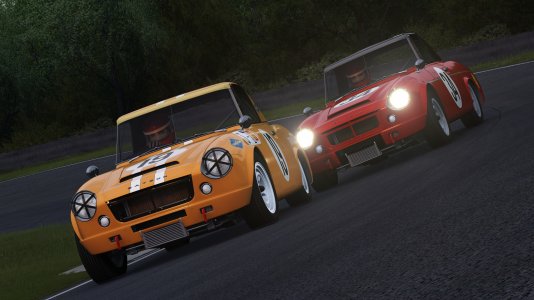
The Clubman race version is right at home at a classic Oulton Park.
Another classic work of art, the Datsun Fairlady 2000 (SR311), alongside its racing clubman version, has been brought to Assetto Corsa by the usual suspects: Pasta2000, Alguecool, and Bazza, with help from Benjamin Nash.

This mod comes in two parts: a download for the race car and a separate one for the road car version of this Fairlady. Choose the club man variant if you want to go wheel to wheel with legendary 1960s racing machinery. However, if you prefer cruising the open road and Japanese mountain passes, there is also an option for you!

Comparison.jpg

Datsun Fairlady 2000 (SR311) and Clubman racing varient. Images: Pasta2000

The history of the Datsun Fairlady 2000 (SR311)​

Although somewhat overshadowed by its younger and much more famous brother, the Fairlday Z, this Japanese sportscar, the Datsun Fairlady 2000, was a fantastic work of art from the late 1960s. The Fairlady's small frame and nimble suspension setup made it the perfect car for track and tarmac rally stages around the globe.

Japanese sportscars often suffer from the 'MX-5' stereotype of being fast in the corners but miserable at achieving impressive top-speed numbers. This Fairlday had something to say about that. The SR311 variant of the Fairlady was the first Japanese car to reach 200KPH.

Drift.jpg

The SR311 Clubman loves to break traction if you push those 1960s tyres too hard.

The engine size of the second generation Datsun Fairlady started with a 1500cc unit, earning that generation the "1500" tag in 1962. The car eventually reached its final form, and whilst going Super Saiyan is a bit of an overstatement, the car managed to have a 2000cc engine crammed into it, nicknamed the "Fairlady 2000" SR311.

The combination of the U20 engine, the 1,982cc 4-cyl inline-four, and Solex twin carburettors generated a maximum output of 145ps. Thanks to the Porsche-derived 5-speed manual transmission, the car achieved a maximum speed of 205 kph.

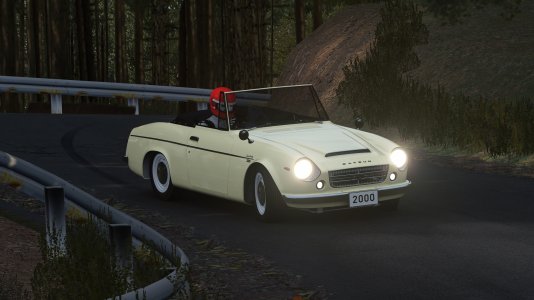
Road Car Exterior.jpg

The road-going version of the Fairlady is a bit floaty, but it is excellent to drive on the limit regardless.

As mentioned earlier, the SR311 was known as the first Japanese car to break through the metaphorical wall of 200km/h. However, it wasn't just a show car with one top-speed trick up its proverbial sleeve. The SR311 also achieved results in motorsport disciplines around the globe, such as the 1967 Japan GP and the 1968 Rallye Monte-Carlo. It was often seen at events under factory and privateer teams until the release of the Fairlady's successor, the Fairlady Z, in 1969.

T1 Crash.jpg

The AI have not quite mastered the SR311...

A great addition to the classic racers collection​

Whether you enjoy racing or cruising, this Datsun Fairlady mod is expertly crafted for your enjoyment. Bazza has crafted the physics, so you know the level of quality to expect. Alguecool and mod publisher Pasta2000 created the model and textures. This combination of modding talent has produced a fantastic homage to a somewhat forgotten car.

I2.jpg

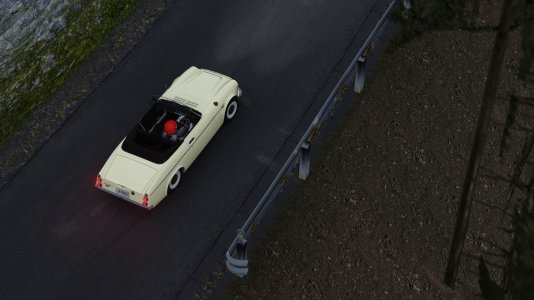
Cruising through the Japanese mountains has never felt more appropriate.

Have you tried this duo of 1960s sportscars yet? What do you think about them? Let us know in the comments down below!
About author
Connor Minniss
Website Content Editor & Motorsport Photographer aiming to bring you the best of the best within the world of sim racing.

Comments

Whenever I see something historic in AC it is usually Bazza Bazza... That guy must be doing things very well and quickly. I haven't tried anything from those people yet, despite their content being widely celebrated for over 6 years already, ever since they toped over Grand Prix Legends, it is about how much time I wasn't playing AC.

So many cars, wow. Certainly simracers wouldn't love stuff if it wasn't highest tier and out of the most honest origins - from love, would they ?
 
As if your Porsche 912 is the golden standard in physics, with a rear roll center height of 64 cm above the ground... In reality a 911 is in the range between 8-15 cm depending on year
View attachment 818462
That is semi trailing arm geometry, wouldn't it be the case that this editor is calculating it as DWB geometry ?
 
The OHC Datsun straight 6 engine has nothing in common with the OHV Austin straight 6 engine except making the OHV Austin engine a boat anchor!
I stand corrected there.I must either not remembered the conversation correctly or been given bad info.Makes sense with the OHV limiting the power that the Healeys can make.
 
That kind of DWB geometry wouldn't have an RCH very far off; it's just that the whole editor is wrong to begin with.
The way that editor picks it up, it is probably at front at the car and at the top of the wheels. I wonder why @Stereo is not defending his design. Maybe it is not worth teaching unwashed masses ? Maybe it really isn't worth it.

The subject is interesting of semi trailing arms, it is more common with older cars. I suppose guy like Bazza would have encountered it a few times at least.

I have made my geometry for 911s for rF2 a bit differently. I am not entirely sure of how to make trailing arms either. I have had it with many cars though, some 50s cars had it in front. Aston Martins, Lancia D24, Porsche 550. Minis had it in rear. My Opel Omega which I used to own had very similar geometry to old 911 :D

I remember the first time I did that geometry for 911 I also converged arms at body connection points the way Stereo has done. But later I have noticed better results if I keep the bottom and upper arms parallel. And have slight sweep angle:
https://res.cloudinary.com/engineer...87889009/tips/BMW_2002_vs_E30_arms_xuhkjs.png

 
I am player of rF2, but I enjoy seeing these cars appearing to AC too. I hope that they also receive great physics. With datas and everything :D To me best data is real car videos and pictures ! Oh yes, still pictures too.
 
I remember the first time I did that geometry for 911 I also converged arms at body connection points the way Stereo has done. But later I have noticed better results if I keep the bottom and upper arms parallel. And have slight sweep angle:
The correct method is to have the inboards meet at two points. It doesn't matter where the outboards are. The simplest version would be two joints at the inboards. I don't know what "better results" mean for you, but you're not going to get them doing that, unless there's a problem with internal forces or something. Vanilla AC has such a problem, but it's a thing of the past nowadays. Stereo's 912 uses the antisquat fix, so the geo is fine.

The problem with the KS editor is that it's 2D and doesn't know how to take longitudinal IC position into account. Don't use it, use an actual analysis software.
 
I also think that Stereos geometry is fine @ArchTheSecond , in rF2 I had something wrong long ago with such literal representation, I don't remember exactly what it was. But at the time I also had several other problems with my physics. So perhaps should try again to do rear geo where inboard points meet up at the hinges. naturally it would make great sense that points at the spindle would both follow same arch, however, when bottom and upper arms are parallel, then the spindle points remain more vertical through wheel travel, it might be better for bumpsteer control perhaps, or maybe it is same for each scenario. In rF2 for a long time I had instability problems, till it turned out that I just needed to rise tire pressures quite a bit :D

I have never really worked on geometry for AC, so I don't know many nuances. Can you recommend some suspension geometry analysis software ?
 
Can you recommend some suspension geometry analysis software ?
I use SHARK. It's not for sale anymore. Maybe you can find an ancient version.

Performance Trends Suspension Analyzer is the common one, I don't know how powerful it is. It's pretty cheap, not in the upper thousands of dollars, more like lower hundreds.
 
The way that editor picks it up, it is probably at front at the car and at the top of the wheels. I wonder why @Stereo is not defending his design. Maybe it is not worth teaching unwashed masses ? Maybe it really isn't worth it.
Mainly cause I never claimed otherwise so I don't have anything to defend. But since you ask, there are too many factors in play to say why it's the way it is
- it's not a stock 912, it's a specific car set up for road racing by an amateur
- my design process doesn't use that suspension visualizer, so I have no way of knowing whether it lists the correct RC that you'll experience in AC
- I am not trying to build the most accurate possible mods, I apply a consistent process that gets things finished
- for all I know 8-15cm is also wrong, I never encountered an RC number for a 912
 
Last edited:
@Stereo I have not driven your 912R, yet. Because I have not been in AC. But I am quite certain that it probably passes over 80% of realism, which is perhaps already more than majority can appreciate and identify. It also looks great. Quite likely RH is higher as I see the car is lowered a lot. I have read in the pelican forum, although one can suspect, lowering it too much messes RC heights, and requires some redesigning of pickup points.

I think the geometry although important is over rated, comparing to tires and aerodynamics. These old cars very often has way too optymistic aero in simulations. This being said, I wonder what lowering of early 911 body shape does to aero. I suspect it might reduce front lift, and not so much rear lift ?

This Datsun also probably should have "stunning" aerodynamics for its size. Like Miata, and probably more lift.
 
My perplexion with the popular mods of classic cars is, how are some of them so different in handling from others? Like, 60s ACL GTC are soft and wobbly, early 70s ACL GTR are much more stable — sounds fine, since they're also a different class. But then late-70s DRM Revival cars are so difficult to control, and try to steer off the road with just a bit of unsteady input, despite having pretty beefy aero. Even 60s ACL protos are more predictable.

So, are ACL mods too forgiving, or are DRM too hardcore?
 
My perplexion with the popular mods of classic cars is, how are some of them so different in handling from others? Like, 60s ACL GTC are soft and wobbly, early 70s ACL GTR are much more stable — sounds fine, since they're also a different class. But then late-70s DRM Revival cars are so difficult to control, and try to steer off the road with just a bit of unsteady input, despite having pretty beefy aero. Even 60s ACL protos are more predictable.

So, are ACL mods too forgiving, or are DRM too hardcore?
DRM Revival cars are an altogether different class too, they represent the most extreme Group 5 machinery ever seen, being extremely modified in bodywork for aero, and some even featuring venturi tunnels in the underfloor for ground effects, with also massive power outputs.

Not a straight comparison.
 
My perplexion with the popular mods of classic cars is, how are some of them so different in handling from others? Like, 60s ACL GTC are soft and wobbly, early 70s ACL GTR are much more stable — sounds fine, since they're also a different class. But then late-70s DRM Revival cars are so difficult to control, and try to steer off the road with just a bit of unsteady input, despite having pretty beefy aero. Even 60s ACL protos are more predictable.

So, are ACL mods too forgiving, or are DRM too hardcore?
Most physics modders don't have a clue what they're doing, and this is exaggerated by historical cars and tires which are not well understood and rife with folklore and magical thinking.
 
DRM Revival cars are an altogether different class too, they represent the most extreme Group 5 machinery ever seen, being extremely modified in bodywork for aero, and some even featuring venturi tunnels in the underfloor for ground effects, with also massive power outputs.

I'm not seeing that high class stuff in the mod.

- accelerates like a train

- steers like a boat

- at the same time, sensitive to not-too-smooth inputs like a neurotic

- brakes like a train again

- can't drive straight without veering to a side, even with fully locked diff

- tire options are either endurance for hours of driving, or ones that get cooked from a bit of a slide

Not sure what that aero is doing.
 
Last edited:
I'm not seeing that high class stuff in the mod.

- accelerates like a train

- steers like a boat

- at the same time, sensitive to not-too-smooth inputs like a neurotic

- brakes like a train again

- can't drive straight without veering to a side, even with fully locked diff

- tire options are either endurance for hours of driving, or ones that get cooked from a bit of a slide

Not sure what that aero is doing.
Compared to what? All the things you are mentioning are relative.
 
Most physics modders don't have a clue what they're doing, and this is exaggerated by historical cars and tires which are not well understood and rife with folklore and magical thinking.
THIS. I call it "Perceived Handling Syndrome", and it plagues sim racing, from free AC mods to the lowest of the low paid experiences, Forza. Its basically what people THINK certain cars should handle like, even if they have no personal experience with said car. Take the Brabham BT24 for example, a car featured across multiple titles. My father restored and raced a customers BT24 in the mid-90s at Watkins Glen(pictured). He's told me it was one of the most predictable cars to drive, very similar to a F2 or Formula B(Americas F2 variant in the 60s that eventually became Formula Atlantic), but with 300+ horsepower. He had NEVER DRIVEN AND F1 CAR BEFORE, and yet he said the experience was quite pleasant(Until a Lotus 79 passed him at like 180mph while he was doing ~150mph). Meanwhile, everywhere else, the BT24 is a twitchy, wandering, no grip having MONSTER, that is honestly UNpleasant to drive. I had him use it on my rig and his only reaction was "Yeah, this isn't right at all" and left. All because the legend of F1 cars in the 60s being death traps makes people thing they were hard to drive. They weren't hard to drive, per say, they were hard to MASTER.

Meanwhile, as far as cars I have experience with, Legions McLaren M4 F2 and FB car, as well as Bazzas F2 and F3 cars, even though i drive Brabhams and not McLaren/Matra/Techno, the feel is spot on, and I can do similar times to what i do IRL at my local track. And yet other mods, like the Alexis Formula Ford is sooooo far off that myself and my friends who race vintage FF cannot STAND it. It understeers, its oversteers, it has no lateral grip, and actually has slightly too much power somehow, even though the numbers are accurate,

Long Essay short, whenever I see "This car doesn't handle correctly" or "This is unrealistic" I always have to ask "and how would you know?" I personally cannot attest to how accurate a 917K is, but a Formula Ford I have a lot of experience with. The issue is most "vintage" tires in sim racing might as well be made of stone. I found using CM, creating my own tire compound by mixing the Vintage compound and the hard F1 compound actually gave a similar feel to the tires historic cars use nowadays.

92947946_2985859658118792_4627621828859265024_n.jpg
 
THIS. I call it "Perceived Handling Syndrome", and it plagues sim racing, from free AC mods to the lowest of the low paid experiences, Forza.
Don't worry, it's a feature of all consumer sim models, paid or not, and probably most professional ones too. I think most cars are made with hopes and dreams.

The issue is most "vintage" tires in sim racing might as well be made of stone. I found using CM, creating my own tire compound by mixing the Vintage compound and the hard F1 compound actually gave a similar feel to the tires historic cars use nowadays.

View attachment 820056
Actual real historical tires aren't comparable to modern reproductions. That's part of why historical cars are hard/impossible to make accurate sim models for, the tire data isn't sufficient, and nobody who is alive has an opinion of them that you can trust. The most reasonable method is probably correlating the car on repros, then using further simulation to estimate historical tires.
 
I guess it's a question of whether one wants to use data that is available and make old cars drive like they currently do IRL with repro or modern tyres, or guesstimate and attempt to make them drive like they might have when new..
 

Article information

Author
Connor Minniss
Article read time
3 min read
Views
7,178
Comments
42
Last update

With WRC leaving EA/Codemasters :Who will be blessed with the new WRC license?

  • Sabre

    Votes: 13 1.9%
  • KT Racing

    Votes: 61 8.8%
  • Milestone

    Votes: 87 12.5%
  • The Last Garage

    Votes: 11 1.6%
  • BeamNG

    Votes: 135 19.4%
  • iRacing

    Votes: 107 15.4%
  • Straight4 Studios

    Votes: 8 1.1%
  • Bugbear Entertainment

    Votes: 25 3.6%
  • Motorsport Games / Studio 397

    Votes: 61 8.8%
  • Kunos Simulazioni

    Votes: 98 14.1%
  • Reiza Studios

    Votes: 67 9.6%
  • Other (add in the comments below)

    Votes: 23 3.3%
Back
Top