Formula One is celebrating its 75th anniversary since the inaugural World Championship season in 1950. It has been an incredible journey to the modern day. Gentlemen, a short view back to the past...
In 2025, Formula One celebrates its 75th anniversary—a milestone that marks not only the endurance of a sport but also the evolution of an entire culture built on speed, technology, and the relentless pursuit of excellence. What began as a niche motorsport in post-war Europe has grown into a multibillion-dollar global spectacle, captivating hundreds of millions around the world with its drama, innovation, and iconic rivalries.

Mercedes, China 2025. Image: Formula One
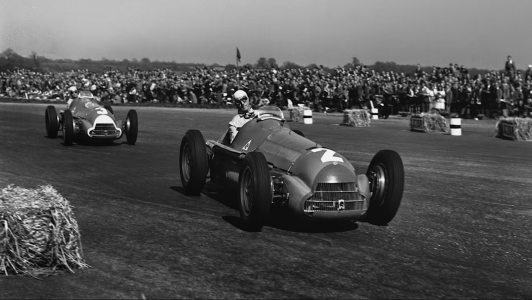
Giuseppe Farina, driving for Alfa Romeo, became the first-ever World Champion, narrowly beating teammate Juan Manuel Fangio — a name that would become legendary in the sport. European manufacturers dominated the early years of Formula One and primarily raced on road circuits and airfields that barely resembled the modern tracks we know today.

Formula One's first World Champion, Nino Farina. Image: Formula One
For those Assetto Corsa fans, many of these historic circuits are available to download right here on OverTake in our downloads section. From cars to tracks and liveries, there is a ton to fire up your time machine with.

A young Stirling Moss meeting the King of England before his 500cc support race. Image: Formula One
Moss won his heat and was involved in a barnstorming battle for the lead in the final, but in the end, he had to settle for second place after his Cooper-JAP suffered catastrophic piston failure at the final corner. Still, at least he met King George VII and Queen Elizabeth II.
The 1970s saw the rise of commercial sponsorships, the increasing importance of aerodynamics in car design, and the beginning of safety reforms. Teams like Ferrari, McLaren, and Lotus battled not just on the track but in the wind tunnel. Legendary drivers such as Niki Lauda and James Hunt brought charisma and rivalry to the front pages week in and week out.
In the 1980s and 1990s, the technological arms race intensified. Turbocharged engines, electronic systems, and carbon fibre chassis revolutionised performance. Ayrton Senna, Alain Prost, and Nigel Mansell became household names, representing not only supreme talent but also the increasingly global appeal of F1. Senna's tragic death in 1994 marked a turning point, catalysing serious safety innovations that have since saved drivers' lives.
The 2000s and 2010s were characterised by dominance and disruption. Michael Schumacher's record-breaking seven titles (later equalled by Lewis Hamilton) made him one of the sport's most iconic figures. Red Bull's rise, the hybrid engine era, and Mercedes-AMG's unprecedented success reshaped the competitive landscape.

Sebastian Vettel, Indian Grand Prix 2013. Image: Red Bull Content Pool / Getty Images
The skiing accident that so cruelly disabled Schumacher still lives in the memory of the paddock and fans alike. At this 75-year celebration, Schumacher is remembered and cherished as he remains under constant care in the privacy of his home.
Moving into the 2020s, Hamilton would wrap up the 2020 season in what many fans see as the most incredible Formula One car ever created, the W11. The car had a stunning win percentage of 76.5%, with the large majority of those wins going to Lewis Hamilton.

Lewis Hamilton, Mercedes W11 at pre-season testing. Image: Artes Max via WikiMedia Commons, CC BY-SA 2.0
In 2021, the British dominance would come to an end as Max Verstappen claimed his first-ever World Championship for Red Bull. 2022, 2023, and 2024 would all go to the Dutchman as well, in a theme that reminded many fans of the early 2010s Red Bull dominance.
In 2025, it appears to be the year of McLaren. With Lando Norris and Oscar Piastri behind the wheel, the papaya squad is looking set to dethrone Verstappen and Red Bull for the first time in four years.
The Liberty Media Era: Since acquiring F1 in 2017, Liberty Media has prioritised digital engagement, fan access, and global expansion. From behind-the-scenes documentaries like Drive to Survive to revamped race calendars reaching new territories (Saudi Arabia, Miami, Las Vegas), F1 has grown its audience significantly, especially among younger fans.

Bahrain Grand Prix opening lap. Image: Red Bull Content Pool / Getty Images
Sustainability and Technology: As climate concerns intensify, Formula One has committed to becoming net-zero carbon by 2030. Hybrid power units have become more efficient, and synthetic fuels and electric elements are under active development. F1 remains a test bed for automotive innovation — but now with a clear focus on sustainability.
Diversity and Inclusion: The We Race As One campaign, launched in 2020, aimed to address underrepresentation in motorsport. Though progress has been gradual, initiatives to support women, minorities, and low-income entrants into racing and engineering roles are beginning to change the face of F1, both on and off the grid.
Regulatory Evolution: The new generation of cars introduced in 2022 aimed to improve overtaking and level the competitive playing field. With closer racing and budget caps, the sport has tried to reduce the dominance of a few teams and inject more unpredictability — something fans had long demanded.
Some of the most anticipated highlights include the Heritage Parade at Silverstone, which will showcase iconic cars from each decade of Formula One, driven by legends Alain Prost, Jackie Stewart, and Sebastian Vettel.
The Global F1 Exhibition Tour is a travelling museum-style exhibition featuring classic F1 machines, memorabilia, and interactive experiences that will be displayed across multiple Grand Prix this year.
There is also a 75 Years of Champions Gala, a star-studded ceremony ahead of the Monaco Grand Prix that celebrates every world champion in attendance.

Michael Schumacher driving for Benetton in 1992. Image: Iwao via WikiMedia Commons, CC BY 2.0
It is clear that Formula One is continuing its upward trajectory in social popularity on the likes of TikTok and Reddit, as well as more traditional media. 2025 was a record year of viewership since the anomaly of the 2020 season. The sport has survived wars, recessions, and controversy. There are no signs of it slowing down as the premier racing series in the world.
What are your favourite memories from the seventy-five years of Formula One? How many Grand Prixs have you attended? Let us know in the comments down below!
In 2025, Formula One celebrates its 75th anniversary—a milestone that marks not only the endurance of a sport but also the evolution of an entire culture built on speed, technology, and the relentless pursuit of excellence. What began as a niche motorsport in post-war Europe has grown into a multibillion-dollar global spectacle, captivating hundreds of millions around the world with its drama, innovation, and iconic rivalries.
Mercedes, China 2025. Image: Formula One
The Birth of Formula One
Formula One's origins trace back to May 13, 1950, when the first official World Championship race was held at Silverstone in the United Kingdom. It was a defining moment, bringing together the best drivers and teams under a new unified rule set. Though Grand Prix racing had existed for decades before, the formalisation of the "Formula One" name introduced a rigid structure that would later see prestige and a narrative that fans could follow year after year with returning teams and drivers.Giuseppe Farina, driving for Alfa Romeo, became the first-ever World Champion, narrowly beating teammate Juan Manuel Fangio — a name that would become legendary in the sport. European manufacturers dominated the early years of Formula One and primarily raced on road circuits and airfields that barely resembled the modern tracks we know today.
Formula One's first World Champion, Nino Farina. Image: Formula One
For those Assetto Corsa fans, many of these historic circuits are available to download right here on OverTake in our downloads section. From cars to tracks and liveries, there is a ton to fire up your time machine with.
Fun Fact: Stirling Moss came second in the support race
Stirling Moss would go on to win the British Grand Prix in 1955 and 1957, but at the inaugural World Championship Grand Prix in his homeland, the then 20-year-old only appeared in the 500cc support races, not in the main event.A young Stirling Moss meeting the King of England before his 500cc support race. Image: Formula One
Moss won his heat and was involved in a barnstorming battle for the lead in the final, but in the end, he had to settle for second place after his Cooper-JAP suffered catastrophic piston failure at the final corner. Still, at least he met King George VII and Queen Elizabeth II.
Decades of Change and Progress
Over the past 75 years, Formula One has transformed dramatically. The 1950s and 1960s were defined by daring drivers and mechanical ingenuity, but also by danger. Safety was minimal, and fatalities were tragically common. Heroes like Alberto Ascari, Wolfgang Graf Berghe von Trips and many more lost their lives doing what they loved, pushing for performance in an era when the risks were ever-present.The 1970s saw the rise of commercial sponsorships, the increasing importance of aerodynamics in car design, and the beginning of safety reforms. Teams like Ferrari, McLaren, and Lotus battled not just on the track but in the wind tunnel. Legendary drivers such as Niki Lauda and James Hunt brought charisma and rivalry to the front pages week in and week out.
In the 1980s and 1990s, the technological arms race intensified. Turbocharged engines, electronic systems, and carbon fibre chassis revolutionised performance. Ayrton Senna, Alain Prost, and Nigel Mansell became household names, representing not only supreme talent but also the increasingly global appeal of F1. Senna's tragic death in 1994 marked a turning point, catalysing serious safety innovations that have since saved drivers' lives.
The 2000s and 2010s were characterised by dominance and disruption. Michael Schumacher's record-breaking seven titles (later equalled by Lewis Hamilton) made him one of the sport's most iconic figures. Red Bull's rise, the hybrid engine era, and Mercedes-AMG's unprecedented success reshaped the competitive landscape.
Sebastian Vettel, Indian Grand Prix 2013. Image: Red Bull Content Pool / Getty Images
The skiing accident that so cruelly disabled Schumacher still lives in the memory of the paddock and fans alike. At this 75-year celebration, Schumacher is remembered and cherished as he remains under constant care in the privacy of his home.
Moving into the 2020s, Hamilton would wrap up the 2020 season in what many fans see as the most incredible Formula One car ever created, the W11. The car had a stunning win percentage of 76.5%, with the large majority of those wins going to Lewis Hamilton.
Lewis Hamilton, Mercedes W11 at pre-season testing. Image: Artes Max via WikiMedia Commons, CC BY-SA 2.0
In 2021, the British dominance would come to an end as Max Verstappen claimed his first-ever World Championship for Red Bull. 2022, 2023, and 2024 would all go to the Dutchman as well, in a theme that reminded many fans of the early 2010s Red Bull dominance.
In 2025, it appears to be the year of McLaren. With Lando Norris and Oscar Piastri behind the wheel, the papaya squad is looking set to dethrone Verstappen and Red Bull for the first time in four years.
The 21st-Century Revolution
Now, in 2025, Formula One stands at a crossroads. The past decade has seen a significant shift in how the sport is presented, consumed, and governed, leading to a lot of disruption, but some great racing has been on show between the controversiesThe Liberty Media Era: Since acquiring F1 in 2017, Liberty Media has prioritised digital engagement, fan access, and global expansion. From behind-the-scenes documentaries like Drive to Survive to revamped race calendars reaching new territories (Saudi Arabia, Miami, Las Vegas), F1 has grown its audience significantly, especially among younger fans.
Bahrain Grand Prix opening lap. Image: Red Bull Content Pool / Getty Images
Sustainability and Technology: As climate concerns intensify, Formula One has committed to becoming net-zero carbon by 2030. Hybrid power units have become more efficient, and synthetic fuels and electric elements are under active development. F1 remains a test bed for automotive innovation — but now with a clear focus on sustainability.
Diversity and Inclusion: The We Race As One campaign, launched in 2020, aimed to address underrepresentation in motorsport. Though progress has been gradual, initiatives to support women, minorities, and low-income entrants into racing and engineering roles are beginning to change the face of F1, both on and off the grid.
Regulatory Evolution: The new generation of cars introduced in 2022 aimed to improve overtaking and level the competitive playing field. With closer racing and budget caps, the sport has tried to reduce the dominance of a few teams and inject more unpredictability — something fans had long demanded.
Celebrating 75 Years
In honour of its 75th anniversary, Formula One has announced a year-long celebration across the 2025 calendar. Historic racecars will appear at Grands Prix, retired champions will return for special appearances, and commemorative events will pay tribute to key moments in the sport's history.Some of the most anticipated highlights include the Heritage Parade at Silverstone, which will showcase iconic cars from each decade of Formula One, driven by legends Alain Prost, Jackie Stewart, and Sebastian Vettel.
The Global F1 Exhibition Tour is a travelling museum-style exhibition featuring classic F1 machines, memorabilia, and interactive experiences that will be displayed across multiple Grand Prix this year.
There is also a 75 Years of Champions Gala, a star-studded ceremony ahead of the Monaco Grand Prix that celebrates every world champion in attendance.
The Road Ahead
As F1 enters its next quarter-century, it faces critical questions: How will it balance spectacle with sustainability? Will future stars captivate fans the way Senna, Schumacher, or Hamilton did? Can the sport remain innovative without alienating traditionalists?Michael Schumacher driving for Benetton in 1992. Image: Iwao via WikiMedia Commons, CC BY 2.0
It is clear that Formula One is continuing its upward trajectory in social popularity on the likes of TikTok and Reddit, as well as more traditional media. 2025 was a record year of viewership since the anomaly of the 2020 season. The sport has survived wars, recessions, and controversy. There are no signs of it slowing down as the premier racing series in the world.
What are your favourite memories from the seventy-five years of Formula One? How many Grand Prixs have you attended? Let us know in the comments down below!