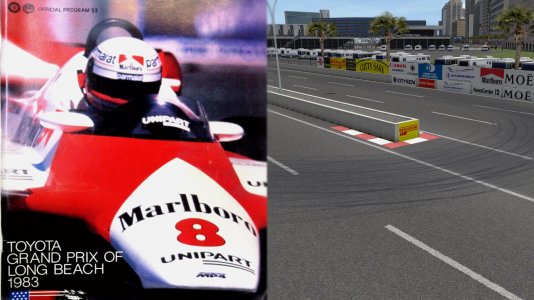
Hailed as one of the most incredible drives in Formula One history, the great John Watson's charge from the back of the grid to victory around the streets of Long Beach in 1983 has now been immortalised in Assetto Corsa!
Despite having a star-studded driver lineup with Watson and Niki Lauda, McLaren's 1983 Formula One season was not a standout year. The year's peak came in California, where the duo finished first and second after an incredible showing riddled with teamwork and intelligent driving.

Long Beach 1983 layout. Image: RacingCircuits.info
Just twelve of the twenty-six cars that qualified for the Grand Prix finished the race, with thirteenth-place Eddie Cheever, driving for Renault at the time, being classified in the final results despite a crash late in the race.
Mechanical failures were a dime a dozen at this point in Formula One, so much of the retirement came from the equipment overheating. However, driver fatigue also played a part in the case of Arrows driver Alan Jones, who retired after struggling with dehydration. The heat of battle would also get to reigning World Champion Keke Rosberg when he put himself and Ferrari driver Patrick Tambay out of the race with an audacious move, blinded by impatience and fatigue.

John Watson, 1983 Race of Champions. Image: Martin Lee via CC BY-SA 2.0
Before this incredible charge, Toleman driver Derek Warwick was the first of the leaders to fall foul of the challenging Long Beach circuit. A self-induced spin saw his car stranded with too much damage to the cooling system of the Hart-engined Toleman car for the Brit to carry on.
Meanwhile, back at the front, Rosberg was all over the back of the scarlet Ferrari of Patrick Tambay; the Williams did not suffer from the crippling turbo lag that plagued that year's Ferrari as the team was still using naturally-aspirated Cosworth DFV engines at this point.
The battle for the lead was spiced up by an impatient Rosberg, who forced his way up the inside of Tambay, going into the Le Gasomet hairpin. The Finn slammed on the brakes to make the corner without hitting the Ferrari. However, the audacious move launched the Ferrari into the air instead, immediately retiring Tambay.
Jacques Laffite in the other Williams was gifted the lead, and despite his best efforts, the day was to go with the charging McLarens of Watson and Lauda.

Jacques Laffite's 1983 Williams. Image: David Merrit via CC BY 2.0
Although they had qualified 22nd and 23rd on the vastly inferior Michelin tyres, Niki Lauda and John Watson did what teammates were supposed to do and worked together. Not only did this bring home a one-two for the team and vital points, but it also bolstered their relationship as a duo on a track that would lead to a few more successful outings through 1983 despite neither driver getting within touching distance of the World Championship in what was a poor McLaren by the brands' standards.
The tight 90-degree corners and harsh hairpins make this circuit a real challenge, regardless of whether you tackle this track in period-correct machinery or with a class like GT3 or TCR. The bumps are unforgiving, and the barriers even more so.
This rFactor port is a solid example from shin956; the tarmac feels slippy and can throw you into a wall at any moment, but when you manage to hook a whole lap together at racing speed, there are very few feelings like it available in Assetto Corsa!

Image: shin956
What do you think about the 1983 Long Beach Grand Prix circuit? Is this layout better than the current one? Let us know in the comments down below!
Despite having a star-studded driver lineup with Watson and Niki Lauda, McLaren's 1983 Formula One season was not a standout year. The year's peak came in California, where the duo finished first and second after an incredible showing riddled with teamwork and intelligent driving.
The History of the 1983 United States Grand Prix West
The Long Beach circuit, still used in IndyCar today, has remained unchanged since 2000. However, the 1983 layout was a different beast entirely. With plenty of 90-degree corners, hairpins, and tight sections where barriers were just inches away from the exposed wheels, the 1983 United States Grand Prix West was untamable for most of the field.Long Beach 1983 layout. Image: RacingCircuits.info
Just twelve of the twenty-six cars that qualified for the Grand Prix finished the race, with thirteenth-place Eddie Cheever, driving for Renault at the time, being classified in the final results despite a crash late in the race.
Mechanical failures were a dime a dozen at this point in Formula One, so much of the retirement came from the equipment overheating. However, driver fatigue also played a part in the case of Arrows driver Alan Jones, who retired after struggling with dehydration. The heat of battle would also get to reigning World Champion Keke Rosberg when he put himself and Ferrari driver Patrick Tambay out of the race with an audacious move, blinded by impatience and fatigue.
John Watson's Incredible Victory
Starting twenty-second of twenty-six qualifiers, just in front of his McLaren-Ford ally Lauda, Watson worked with his Austrian teammate to work their way up the field through other people's battles and mistakes, eventually clearing the road in front of the pair to streak off into the distance, leaving the rest of the field wondering what hit them!John Watson, 1983 Race of Champions. Image: Martin Lee via CC BY-SA 2.0
Before this incredible charge, Toleman driver Derek Warwick was the first of the leaders to fall foul of the challenging Long Beach circuit. A self-induced spin saw his car stranded with too much damage to the cooling system of the Hart-engined Toleman car for the Brit to carry on.
Meanwhile, back at the front, Rosberg was all over the back of the scarlet Ferrari of Patrick Tambay; the Williams did not suffer from the crippling turbo lag that plagued that year's Ferrari as the team was still using naturally-aspirated Cosworth DFV engines at this point.
The battle for the lead was spiced up by an impatient Rosberg, who forced his way up the inside of Tambay, going into the Le Gasomet hairpin. The Finn slammed on the brakes to make the corner without hitting the Ferrari. However, the audacious move launched the Ferrari into the air instead, immediately retiring Tambay.
Jacques Laffite in the other Williams was gifted the lead, and despite his best efforts, the day was to go with the charging McLarens of Watson and Lauda.
Jacques Laffite's 1983 Williams. Image: David Merrit via CC BY 2.0
Although they had qualified 22nd and 23rd on the vastly inferior Michelin tyres, Niki Lauda and John Watson did what teammates were supposed to do and worked together. Not only did this bring home a one-two for the team and vital points, but it also bolstered their relationship as a duo on a track that would lead to a few more successful outings through 1983 despite neither driver getting within touching distance of the World Championship in what was a poor McLaren by the brands' standards.
1983 Layout in Assetto Corsa
Do you fancy trying this gruelling layout yourself? Well, now you can in Assetto Corsa! Originally an rFactor circuit created by andres_ramos, this now-lost layout of Long Beach has been converted for AC by shin956, with permission.The tight 90-degree corners and harsh hairpins make this circuit a real challenge, regardless of whether you tackle this track in period-correct machinery or with a class like GT3 or TCR. The bumps are unforgiving, and the barriers even more so.
This rFactor port is a solid example from shin956; the tarmac feels slippy and can throw you into a wall at any moment, but when you manage to hook a whole lap together at racing speed, there are very few feelings like it available in Assetto Corsa!
Image: shin956
What do you think about the 1983 Long Beach Grand Prix circuit? Is this layout better than the current one? Let us know in the comments down below!