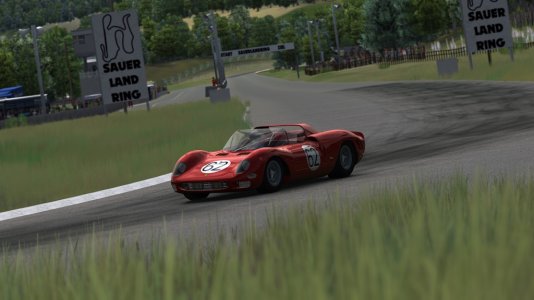
Nearly 54 years after the plans for it went up in smoke, the Sauerlandring is finally ready for racing - in Assetto Corsa, that is. A brand new mod fulfills the vision of Karl von Wendt in sim racing.
Germany and motorsport are basically inseparable. Manufacturers like Mercedes, Audi, Porsche and BMW, a long list of internationally successful drivers with Michael Schumacher sitting at the top, iconic circuits - there is no denying that the country loved and still loves racing, even though interest may have waned in the last decade or so.
The opposite was the case in the 1960s, though. As racing rapidly advanced, plenty of drivers tried their luck, and manufacturers were competing in multiple series at once. Aside from street circuits and airfield tracks, however, Germany only had two permanent racing circuits at the time - the Nürburgring and the Hockenheimring, of course.
But did you know that there were plans for a third one to join them in the late 1960s? As much of a historics fan I am, I have to admit that this one eluded me until now: the Sauerlandring. It was supposed to be built near the village of Gevelinghausen, roughly halfway between Dortmund and Kassel.
The video above shows the pre-update 2.0 version of the track, but the layout remains the same.
Part of the beauty of sim racing is that it can bring back races that would be no longer possible today. In this case, it gives us the chance to experience a track that never saw the light of day - which has to be just as cool if you ask me.
And you have to give it to @Olaf Hülse: Creating the Sauerlandring is no small feat, with precious few references out there. I remember how difficult it was to draw conclusions from the photos that existed of the Prinzenparkrennen in Braunschweig, Germany, when researching my hometown track to recreate it with @Sergio Loro - but that is a track that was actually operational. For the Sauerlandring, not one patch of concrete was poured, so you can imagine the difficulty of researching it.
How come the track never opened, though? For once, the answer was not that locals did not want it to basically sit in their back yard - on the contrary, actually.

Up and down: The Sauerlandring was supposed to be quite a rollercoaster.
Actually a Baron from the Gevelinghausen area, von Wendt came up with the idea of giving its home region its own racing circuit. The 5.3-kilometer track would feature quite drastic elevation changes and a layout that looks fairly modern even compared to current-day tracks.
A model of the track was even shown at the 1967 'Rennwagenschau' (race car show) in Dortmund, and even high-ranking SPD politician Helmut Schmidt was invited to the Sauerland have von Wendt explain his plans to him. The track would be part of a structural improvement plan for the area, similar to how the Nürburgring was built in the Eifel region to improve the struggling region's fortunes.
In general, things looked favorable for the track. The community of Gevelinghausen was in favor of the Sauerlandring, so was the one of the neighboring village of Ramsbeck. The issue was a bit higher up on the ladder - state government did not approve based on the assumption that a race track would make the Elpe Valley less attractive as a recreational area, so it struck down the plans in 1968.

After learning about this decision - from newspapers, no less - the local authorities were predictably unhappy. "It is with great indignation that the municipal council of Gevelinghausen read in the press that the Sauerlandring project had been rejected by cabinet decision on July 9, 1968", quoted the 'Sauerland' magazine in August 1968. "The reasons for rejection given to the press are completely unfounded and reveal an appalling lack of knowledge about the problems of our habitat."
Von Wendt himself was no less incensed, accusing the authorities of not considering his plans objectively: "Every single negative opinion has been analyzed in detail, while the many positive ones have only been dealt with superficially or even withheld from the key authorities." The Baron fought against the decision, but the final "Nein!" was given in 1971 - the Sauerlandring dream was dead.
As von Wendt had already invested a good amount of money into planning the track, he was allowed to build the 'Fort Fun' amusement park nearby - hardly any solace to von Wendt, 34 at the time, who quit racing altogether. He did have a few more successful businesses in the are, but emigrated to Canada in 1985, running a computer company and building another amusement park. Von Wendt passed away in 2006.
The supposed site of the Sauerlandring remains empty to this day and has been part of a nature reserve since 2004.

The Sauerlandring is quite a technical circuit. Other than the main straight, there are hardly any longer full-throttle parts, and the rollercoaster-like elevation changes make many of its corners that much trickier. However, once you learned the layout, it is quite motivating to try and find a few more tenths here and there each lap, as you always feel like you can improve somehwere.
While it may look a bit rough in some places, mostly in the distance, @Olaf Hülse has shown nice attention to detail as well. There are corner signs that, similar to those at the Nürburgring, bear the names of the section of track you are heading into, and many of them pay hommage to drivers of the era, but also von Wendt's family.

Names you might recognize include Willi Kauhsen, a sportscar ace of the 1960s and 70s, and Rolf Stommelen, another jack of all trades who raced in F1 between 1970 and 1978 and lost his life at Riverside in a Porsche 935.
Furthermore, there is Gerhard Mitter, works driver for Porsche and BMW. For the latter, he was one of the drivers for its Formula 2 project, but was tragically killed in practice for the 1969 German Grand Prix at the Nürburgring. At the time, F1 and F2 cars would race together at the Nordschleife for the GP.
Whether or not F1 would have made its way to the Sauerlandring, we will never know. The track was certainly designed with it in mind, and it is good fun in the Lotus 49 in Assetto Corsa at least - so one can dream about this 'what if?' - thanks to this mod project.
Did you know about the Sauerlandring? What are your impressions of the track? Let us know in the comments below!
Germany and motorsport are basically inseparable. Manufacturers like Mercedes, Audi, Porsche and BMW, a long list of internationally successful drivers with Michael Schumacher sitting at the top, iconic circuits - there is no denying that the country loved and still loves racing, even though interest may have waned in the last decade or so.
The opposite was the case in the 1960s, though. As racing rapidly advanced, plenty of drivers tried their luck, and manufacturers were competing in multiple series at once. Aside from street circuits and airfield tracks, however, Germany only had two permanent racing circuits at the time - the Nürburgring and the Hockenheimring, of course.
But did you know that there were plans for a third one to join them in the late 1960s? As much of a historics fan I am, I have to admit that this one eluded me until now: the Sauerlandring. It was supposed to be built near the village of Gevelinghausen, roughly halfway between Dortmund and Kassel.
Sauerlandring In Assetto Corsa: Mod Finally Brings It To Life
Why did I eventually learn about it, though? Assetto Corsa mods, of course! More specifically, the creation of OverTake community member @Olaf Hülse, which portrays the track as it could have been after completion in 1968. The mod was first uploaded in early February of 2025 and has already received a big update, adding more realistic trackside sponsor banners, a refined road mesh, and some more polish in general.Part of the beauty of sim racing is that it can bring back races that would be no longer possible today. In this case, it gives us the chance to experience a track that never saw the light of day - which has to be just as cool if you ask me.
And you have to give it to @Olaf Hülse: Creating the Sauerlandring is no small feat, with precious few references out there. I remember how difficult it was to draw conclusions from the photos that existed of the Prinzenparkrennen in Braunschweig, Germany, when researching my hometown track to recreate it with @Sergio Loro - but that is a track that was actually operational. For the Sauerlandring, not one patch of concrete was poured, so you can imagine the difficulty of researching it.
How come the track never opened, though? For once, the answer was not that locals did not want it to basically sit in their back yard - on the contrary, actually.
Up and down: The Sauerlandring was supposed to be quite a rollercoaster.
Politics Put A Stop To Plans
The Sauerlandring was the idea of Karl von Wendt. Not the best-known name in German racing history, but a driver himself who competed in the World Sportscar Championship in the 1960s, mostly at the Nürburgring, but also in Monza, the Targa Florio, Zeltweg and Spa-Francorchamps. In 1967, as a Porsche works driver no less, he took the title in Division 3 of the European Touring Car Championship, driving a Porsche 911.Actually a Baron from the Gevelinghausen area, von Wendt came up with the idea of giving its home region its own racing circuit. The 5.3-kilometer track would feature quite drastic elevation changes and a layout that looks fairly modern even compared to current-day tracks.
A model of the track was even shown at the 1967 'Rennwagenschau' (race car show) in Dortmund, and even high-ranking SPD politician Helmut Schmidt was invited to the Sauerland have von Wendt explain his plans to him. The track would be part of a structural improvement plan for the area, similar to how the Nürburgring was built in the Eifel region to improve the struggling region's fortunes.
In general, things looked favorable for the track. The community of Gevelinghausen was in favor of the Sauerlandring, so was the one of the neighboring village of Ramsbeck. The issue was a bit higher up on the ladder - state government did not approve based on the assumption that a race track would make the Elpe Valley less attractive as a recreational area, so it struck down the plans in 1968.
After learning about this decision - from newspapers, no less - the local authorities were predictably unhappy. "It is with great indignation that the municipal council of Gevelinghausen read in the press that the Sauerlandring project had been rejected by cabinet decision on July 9, 1968", quoted the 'Sauerland' magazine in August 1968. "The reasons for rejection given to the press are completely unfounded and reveal an appalling lack of knowledge about the problems of our habitat."
Von Wendt himself was no less incensed, accusing the authorities of not considering his plans objectively: "Every single negative opinion has been analyzed in detail, while the many positive ones have only been dealt with superficially or even withheld from the key authorities." The Baron fought against the decision, but the final "Nein!" was given in 1971 - the Sauerlandring dream was dead.
As von Wendt had already invested a good amount of money into planning the track, he was allowed to build the 'Fort Fun' amusement park nearby - hardly any solace to von Wendt, 34 at the time, who quit racing altogether. He did have a few more successful businesses in the are, but emigrated to Canada in 1985, running a computer company and building another amusement park. Von Wendt passed away in 2006.
The supposed site of the Sauerlandring remains empty to this day and has been part of a nature reserve since 2004.
Sauerlandring: Technical Track With Lots Of Elevation Change
Luckily, sim racing does not have to put up with any of the problems von Wendt faced when trying to realize his dream. As a result, over 50 years after its plans fell through, the circuit finally comes to life in Assetto Corsa - and while its layout might not be everyone's cup of tea, it is remarkable to see the track in raceable condition, even if it is "just" in digital form.The Sauerlandring is quite a technical circuit. Other than the main straight, there are hardly any longer full-throttle parts, and the rollercoaster-like elevation changes make many of its corners that much trickier. However, once you learned the layout, it is quite motivating to try and find a few more tenths here and there each lap, as you always feel like you can improve somehwere.
While it may look a bit rough in some places, mostly in the distance, @Olaf Hülse has shown nice attention to detail as well. There are corner signs that, similar to those at the Nürburgring, bear the names of the section of track you are heading into, and many of them pay hommage to drivers of the era, but also von Wendt's family.
Names you might recognize include Willi Kauhsen, a sportscar ace of the 1960s and 70s, and Rolf Stommelen, another jack of all trades who raced in F1 between 1970 and 1978 and lost his life at Riverside in a Porsche 935.
Furthermore, there is Gerhard Mitter, works driver for Porsche and BMW. For the latter, he was one of the drivers for its Formula 2 project, but was tragically killed in practice for the 1969 German Grand Prix at the Nürburgring. At the time, F1 and F2 cars would race together at the Nordschleife for the GP.
Whether or not F1 would have made its way to the Sauerlandring, we will never know. The track was certainly designed with it in mind, and it is good fun in the Lotus 49 in Assetto Corsa at least - so one can dream about this 'what if?' - thanks to this mod project.
Did you know about the Sauerlandring? What are your impressions of the track? Let us know in the comments below!