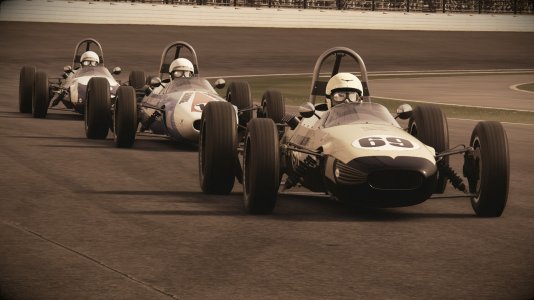
Perhaps an unfairly underrepresented era of IndyCar history, the 1960s provided some of the most entertaining and controversial races, the 1966 Indy 500 being a perfect example. This livery pack lets you experience life behind the wheel of these historic IndyCars, albeit with some quirky differences from their real-life counterparts.
IndyCars of the 1966 and 1967 seasons were rear-engined with significant power that was enough to keep even the most skilled driver on their toes for the entire duration of a race event. The Formula Junior livery pack for Automobilista 2, created by 1Redhottopic, gives you the look without the accompanying difficulty. If you are after a much more challenging experience, check out 1Redhottopic's other livery pack for the Formula Vintage Gen 1 class.

Formula Vintage Gen 1 vs Formula Junior livery pack. Images: 1Redhottopic
The Formula Junior class has significantly less power than its bigger rear-engined brother, the Formula Vintage Gen 1 car. That said, the Formula Junior is no piece of cake to drive. With little to no aero, oversteer is aplenty, especially with the minimal setup options.
The liveries are indeed of good quality, and considering that this livery pack is not on a car of a similar class to what they were initially used on, the proportions are impressive. They are not perfect, but that is to be expected when the proportions of the cars change so dramatically from the original.
During the 1966 Indy 500, the Stewards and the timing desk were confused about the running order. This confusion led to second-place Jim Clark and his team thinking they were the rightful winners. The British driver spun twice during the race but did not make serious contact with another car or barrier, ensuring he was still running for a good result.
Clark's team insisted their driver was a lap ahead of the eventual winner, Graham Hill, at the finish. However, the scoring pylon, which was manually controlled and designed to help spectators rather than dictate the race result, changed the running order sporadically and unreliably. After the scoring was ironed out, much to the dismay of Clark's crew, the unofficial results after the race showed Hill winning by 41.13 seconds over Clark.
The USAC released the official results the morning after the race, and the standings were unchanged. Hill would remain the winner despite the pitlane being in uproar about the lack of professional measures at such an event.
Hill admitted to having an "uneventful race", and the Brit was "puzzled" and "surprised" to be the winner after he thought he was behind his fellow countryman, Clark. However, the IMS Radio Network, which scored the race independently from the USAC officials, also came up with Hill as the first-place car. The apparent controversy died out quickly, and no official action was ever taken.
Years later, the outcome is still hotly debated in classic racing circles. A theory emerged that scorers accidentally omitted one lap from Jim Clark's official tally. Therefore, he was placed behind Hill at the finish, meaning he ran the entire race with a one-lap disadvantage. Al Unser's car was painted nearly identical to Clark's. The theory is that when Al Unser crashed out of the race on lap 161, scorers mistakenly thought it was Clark, and as Clark drove by in the immediate aftermath, they credited that lap to Unser.

Graham Hill's race-winning #24 Lola-Ford T90 "Red Ball Special" Image: Andrew Basterfield via CC BY-SA 2.0
All of these theories are just that. Theories. Graham Hill was the eventual winner on the day, and the record books reflect that. If you want to change history, 1Redhottopic's livery pack for the Formula Junior is the place to do just that!
What do you think about this 1966-67 livery pack for the Formula Junior class in Automobilista 2? Let us know in the comments down below!
IndyCars of the 1966 and 1967 seasons were rear-engined with significant power that was enough to keep even the most skilled driver on their toes for the entire duration of a race event. The Formula Junior livery pack for Automobilista 2, created by 1Redhottopic, gives you the look without the accompanying difficulty. If you are after a much more challenging experience, check out 1Redhottopic's other livery pack for the Formula Vintage Gen 1 class.
Formula Vintage Gen 1 vs Formula Junior livery pack. Images: 1Redhottopic
The Formula Junior class has significantly less power than its bigger rear-engined brother, the Formula Vintage Gen 1 car. That said, the Formula Junior is no piece of cake to drive. With little to no aero, oversteer is aplenty, especially with the minimal setup options.
The liveries are indeed of good quality, and considering that this livery pack is not on a car of a similar class to what they were initially used on, the proportions are impressive. They are not perfect, but that is to be expected when the proportions of the cars change so dramatically from the original.
1966 Indy 500 Controversy
The 1966 Indianapolis 500 was one of, if not the most, confusing and chaotic IndyCar races of the 1960s. There are three potential winners, and nobody, even to this day, knows who the mathematical winner is. Those three drivers were Graham Hill, the registered winner, Jim Clark and American driver Gordon Johncock, who was categorised as finishing 4th when the chequered flag was shown.During the 1966 Indy 500, the Stewards and the timing desk were confused about the running order. This confusion led to second-place Jim Clark and his team thinking they were the rightful winners. The British driver spun twice during the race but did not make serious contact with another car or barrier, ensuring he was still running for a good result.
Clark's team insisted their driver was a lap ahead of the eventual winner, Graham Hill, at the finish. However, the scoring pylon, which was manually controlled and designed to help spectators rather than dictate the race result, changed the running order sporadically and unreliably. After the scoring was ironed out, much to the dismay of Clark's crew, the unofficial results after the race showed Hill winning by 41.13 seconds over Clark.
The USAC released the official results the morning after the race, and the standings were unchanged. Hill would remain the winner despite the pitlane being in uproar about the lack of professional measures at such an event.
Hill admitted to having an "uneventful race", and the Brit was "puzzled" and "surprised" to be the winner after he thought he was behind his fellow countryman, Clark. However, the IMS Radio Network, which scored the race independently from the USAC officials, also came up with Hill as the first-place car. The apparent controversy died out quickly, and no official action was ever taken.
Years later, the outcome is still hotly debated in classic racing circles. A theory emerged that scorers accidentally omitted one lap from Jim Clark's official tally. Therefore, he was placed behind Hill at the finish, meaning he ran the entire race with a one-lap disadvantage. Al Unser's car was painted nearly identical to Clark's. The theory is that when Al Unser crashed out of the race on lap 161, scorers mistakenly thought it was Clark, and as Clark drove by in the immediate aftermath, they credited that lap to Unser.
Graham Hill's race-winning #24 Lola-Ford T90 "Red Ball Special" Image: Andrew Basterfield via CC BY-SA 2.0
All of these theories are just that. Theories. Graham Hill was the eventual winner on the day, and the record books reflect that. If you want to change history, 1Redhottopic's livery pack for the Formula Junior is the place to do just that!
What do you think about this 1966-67 livery pack for the Formula Junior class in Automobilista 2? Let us know in the comments down below!